

Vaccine Manufacturer Excise Tax: A Complete Guide to Filing Form 720
Manufacturers, producers and importers that sell taxable vaccines in the United States must report the federal vaccine excise tax on IRS Form 720, the Quarterly Federal Excise Tax Return. A strong Vaccine excise tax Form 720 process helps your team calculate the tax correctly, meet quarterly deadlines and keep records ready if the IRS requests support.
The vaccine manufacturer excise tax is not a retail sales tax paid by patients or health care providers at the point of vaccination. It is a federal manufacturer-level tax created under Internal Revenue Code Section 4131 and tied to the Vaccine Injury Compensation Trust Fund, often called the VICP. Because the tax is reported quarterly, missing a taxable sale or using the wrong vaccine component count can create filing errors that carry into future periods.
This guide explains who pays, which vaccines are covered, how the 2026 rate works, how to report the tax on Form 720 and why e-filing can reduce avoidable filing friction.
What Is the Vaccine Manufacturer Excise Tax?
The Vaccine Manufacturer Excise Tax is a federal excise tax imposed on certain taxable vaccines sold by manufacturers, producers or importers in the United States. The tax helps fund the Vaccine Injury Compensation Trust Fund, which supports compensation for eligible vaccine-related injury claims under the federal program.
For most businesses, Vaccine excise tax Form 720 reporting starts when a taxable vaccine is sold in the U.S. by the manufacturer, producer or importer. The tax is not based on income, profit margin or the total invoice value. Instead, it is generally calculated by dose and by taxable vaccine component.
In practice, vaccine manufacturers tax IRS compliance means your team must answer three questions before filing:
- Was there a taxable sale during the quarter?
- Is the vaccine included in the taxable vaccine categories under current IRS rules?
- How many taxable vaccine components are included in each dose?
If you need a broader explanation of the return itself before focusing on vaccines, this guide on what Form 720 is used for explains the main excise tax categories and quarterly filing purpose.
Who Must Pay the Vaccine Manufacturer Excise Tax?
The party generally responsible for the vaccine manufacturer excise tax is the manufacturer, producer or importer that makes the taxable sale in the United States. The liability is tied to the taxable vaccine sale, not to the person receiving the shot.
A U.S. vaccine manufacturer that sells a taxable vaccine normally needs to account for the tax. An importer may also be responsible when taxable vaccines are brought into the United States for sale. In contract manufacturing or private-label arrangements, the facts can matter, so businesses should confirm which party is treated as the manufacturer, producer or importer for excise tax purposes.
Clinics, pharmacies, hospitals and physician practices generally do not become liable simply because they administer taxable vaccines to patients. They may pay a price that indirectly reflects tax costs, but the Form 720 reporting responsibility usually sits higher in the supply chain.
New entities should also confirm they have a valid employer identification number before filing federal tax returns. If your business still needs one, you can apply for EIN through the IRS.
Which Vaccines Are Subject to the Federal Excise Tax?
For excise tax on vaccines Form 720 reporting, the product list matters more than the customer type. Taxable vaccines are defined under IRC Section 4132 and reflected in the IRS instructions for Form 720. Covered vaccines generally include vaccines against diseases listed in the statute and current IRS guidance.
Common taxable vaccine categories include the following:
| Vaccine category | Filing note |
|---|---|
| Diphtheria, tetanus and pertussis | Combination products may include multiple taxable components. |
| Measles, mumps and rubella | MMR commonly has three taxable components. |
| Polio | Count as a taxable component when included in a combination vaccine. |
| Hepatitis A and hepatitis B | Each covered disease component is counted separately. |
| Haemophilus influenzae type b | Often appears in pediatric combination vaccines. |
| Varicella | Subject to the federal vaccine excise tax when taxable. |
| Rotavirus | Report based on taxable doses sold. |
| Pneumococcal disease | Covered when listed under current IRS guidance. |
| Seasonal influenza | Generally subject to the vaccine excise tax. |
| Meningococcal disease | Count taxable doses and components. |
| Human papillomavirus | Commonly abbreviated HPV. |
| COVID-19 and pandemic influenza | Confirm current IRS instructions for treatment and reporting. |
This table is a practical overview, not a substitute for reviewing the latest IRS guidance. If a vaccine is newly approved, newly recommended or packaged as a combination product, check the current IRS instructions for Form 720 before filing.
How Is the Vaccine Manufacturer Excise Tax Calculated?
The general federal vaccine tax rate is $0.75 per dose for each taxable vaccine component. A single-component taxable vaccine is usually taxed at $0.75 per dose. A combination vaccine is taxed by multiplying $0.75 by the number of taxable disease components in each dose.
For vaccine tax rate 2026 Form 720 planning, use $0.75 per taxable vaccine component unless the IRS publishes a change. The rate is simple, but the component count can make a meaningful difference.
| Example product | Doses sold in quarter | Taxable components per dose | Calculation | Tax due |
|---|---|---|---|---|
| Single-component hepatitis A vaccine | 10,000 | 1 | 10,000 x 1 x $0.75 | $7,500 |
| MMR vaccine | 5,000 | 3 | 5,000 x 3 x $0.75 | $11,250 |
| DTaP vaccine | 8,000 | 3 | 8,000 x 3 x $0.75 | $18,000 |
| DTaP-IPV-Hib combination vaccine | 4,000 | 5 | 4,000 x 5 x $0.75 | $15,000 |
A practical Vaccine excise tax Form 720 calculation should start with dose-level sales data, then map each product to its taxable components. Finance teams should avoid using gross sales dollars as the tax base because the federal vaccine excise tax is not a percentage of price.
Who Must File Form 720 for Vaccine Excise Tax?
A business must generally file Form 720 if it is liable for federal excise taxes reportable on that return during the quarter. For vaccine tax, this usually means a manufacturer, producer or importer had taxable vaccine sales during the quarter.
In simple terms, a Vaccine excise tax Form 720 return is required when your business has reportable vaccine excise tax liability. If your company has no taxable vaccine sales during a quarter, it may not owe vaccine tax for that category, but it could still need to file Form 720 for other excise taxes, such as fuel, environmental taxes, PCORI fees, communications or indoor tanning services.
Your filing position should be supported by records that show product type, dose counts, sale dates, taxable component determinations, returns or adjustments and any amounts already paid. This documentation is especially important for combination vaccines and product lines that change during the year.
How to Report Vaccine Manufacturer Excise Tax on Form 720
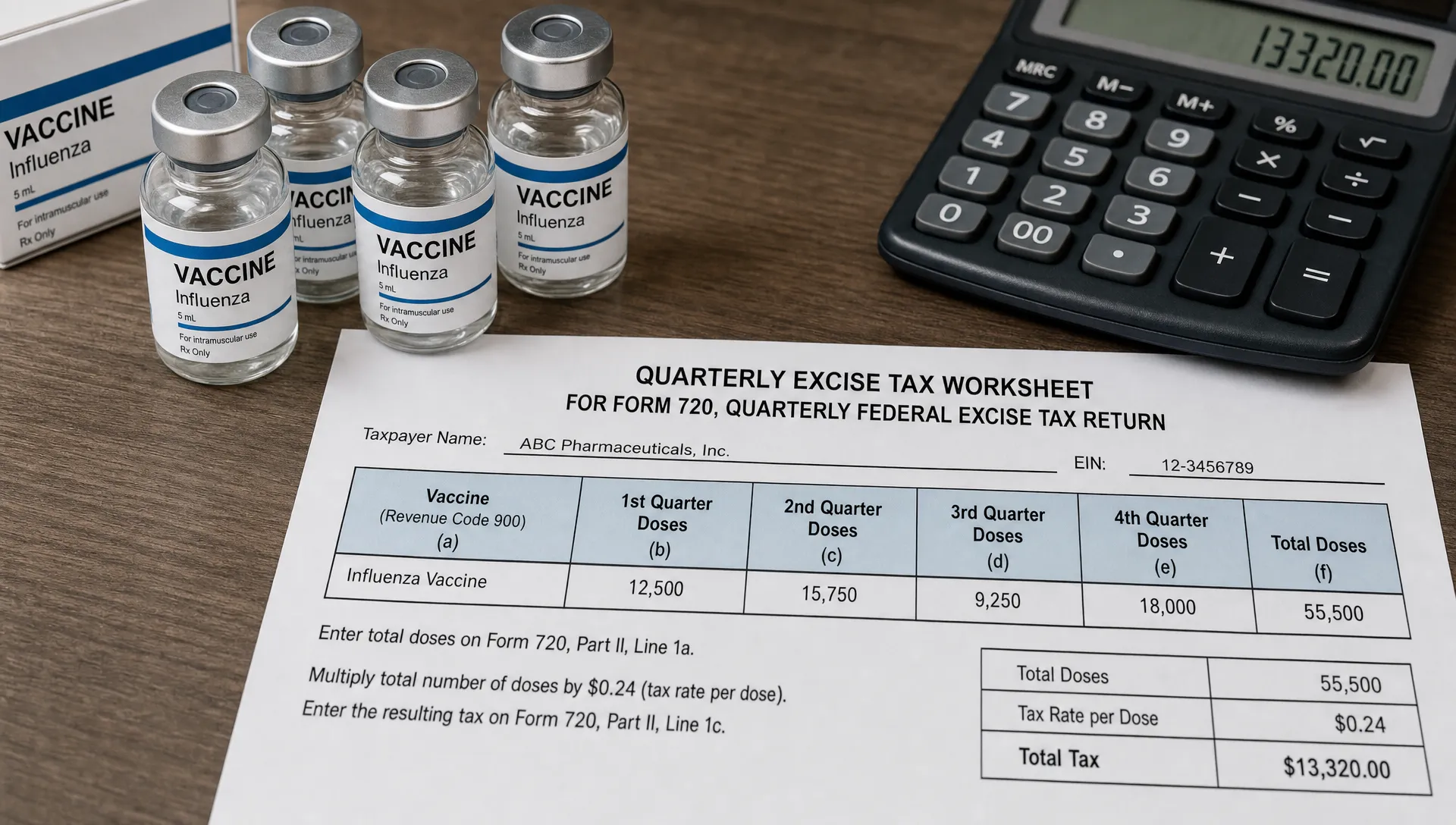
If your team is asking how to file vaccine excise tax, the process is easier when the calculation is completed before you open the return. Form 720 is organized by excise tax category, and vaccine tax is reported under the vaccine line, commonly identified as IRS No. 97 in the Form 720 instructions.
Your Vaccine excise tax Form 720 workflow should follow a consistent quarterly review:
- Identify taxable vaccine sales: Pull all U.S. sales during the quarter for vaccines that may be taxable under IRC Section 4132.
- Map each product to taxable components: Count each covered disease component in every dose, especially for combination vaccines.
- Apply the $0.75 rate: Multiply doses sold by taxable components, then multiply that number by $0.75.
- Enter the tax on Form 720: Report the vaccine tax on the proper vaccine line rather than on unrelated excise tax lines.
- Reconcile totals before submission: Compare the return against sales records, product master data and prior-quarter reporting.
- Keep support documents: Retain workpapers that show how the tax was calculated and who reviewed the filing.
For excise tax on vaccines Form 720 entries, one important control is using the correct IRS number. Do not report vaccine manufacturer excise tax under IRS No. 30, which relates to foreign insurance excise tax. Vaccine tax uses its own reporting line and its own calculation method.
When Is Form 720 Due for Vaccine Excise Tax?
Form 720 is filed quarterly. The due date is generally the last day of the month following the end of the calendar quarter. If the due date falls on a weekend or federal holiday, the deadline moves to the next business day.
The Vaccine excise tax Form 720 deadline follows the same quarterly schedule as other Form 720 excise taxes:
| 2026 quarter | Tax period | Standard due date | 2026 due date note |
|---|---|---|---|
| Q1 | Jan. 1 to Mar. 31, 2026 | Apr. 30 | Apr. 30, 2026 |
| Q2 | Apr. 1 to Jun. 30, 2026 | Jul. 31 | Jul. 31, 2026 |
| Q3 | Jul. 1 to Sep. 30, 2026 | Oct. 31 | Nov. 2, 2026, because Oct. 31 is a Saturday |
| Q4 | Oct. 1 to Dec. 31, 2026 | Jan. 31 | Feb. 1, 2027, because Jan. 31 is a Sunday |
For vaccine tax rate 2026 Form 720 calculations, the rate and the due date are separate issues. The rate determines the amount owed, while the quarterly deadline determines when the return must be submitted and payment made.
Common Vaccine Excise Tax Filing Mistakes to Avoid
Vaccine excise tax filings are often straightforward once the product data is clean, but several mistakes can lead to underreporting, overreporting or delayed processing.
One common error is counting doses without counting components. A combination vaccine may contain several taxable vaccine components, and each component can carry the $0.75 tax. Treating a multi-component product as a single-component product can materially understate the tax.
Another frequent issue is reporting vaccine tax on the wrong Form 720 line. Misreading vaccine manufacturers tax IRS guidance or copying a prior return from a different excise tax category can place the amount under the wrong IRS number. That creates reconciliation problems and may require an amended return.
Businesses should also avoid relying on product names alone. Product names, package descriptions and marketing labels do not always show every taxable disease component clearly. Your tax workpapers should tie back to regulatory product information and current IRS instructions.
Late filing is another preventable problem. Form 720 due dates arrive four times per year, and vaccine manufacturers may have high-volume sales data to reconcile before each deadline. Building a quarter-end checklist helps keep the filing from becoming a last-minute exercise.
Finally, do not ignore corrections. If you discover an error after filing, you may need to amend using Form 720-X. If the facts support a claim or adjustment, Form 8849 may also be relevant. The right correction path depends on what changed, when it changed and how the original return was filed.
Why E-file Form 720 for Vaccine Excise Tax?
E-filing can make vaccine excise tax compliance faster, cleaner and easier to track than preparing a paper return. For manufacturers and importers handling quarterly filings, online filing reduces manual paperwork and helps teams complete the return through a structured process.
A clean Vaccine excise tax Form 720 filing depends on accurate inputs, but an e-file platform can improve the submission experience. eFileExcise720 is an IRS-authorized e-filing portal for Form 720 that supports secure online filing, free account creation, no software download, simple dashboard navigation and personalized customer support.
For vaccine manufacturers, the benefits are practical. You can prepare the return online, review your entries before submission and manage Form 720 filing without mailing paper forms. eFileExcise720 also supports Form 720-X amendments and Form 8849 claims support when those follow-up filings are needed.
E-filing is especially useful for teams that file multiple quarters per year, work across product categories or need a repeatable process for federal excise tax filing. It does not replace your responsibility to calculate the vaccine tax correctly, but it can help reduce administrative friction once your numbers are ready.
Vaccine Manufacturer Excise Tax FAQs
Who must pay the Vaccine Manufacturer Excise Tax? The manufacturer, producer or importer that sells taxable vaccines in the United States is generally responsible for the tax. Health care providers and pharmacies usually do not owe the tax merely because they administer vaccines to patients.
Which vaccines are subject to the federal excise tax? Taxable vaccines generally include vaccines against covered diseases listed under IRC Section 4132 and current IRS instructions, such as diphtheria, tetanus, pertussis, measles, mumps, rubella, polio, hepatitis, influenza, meningococcal disease and other listed categories.
How is the Vaccine Manufacturer Excise Tax calculated? The tax is generally $0.75 per dose for each taxable vaccine component. For example, a three-component combination vaccine sold in 1,000 doses would generally produce 1,000 x 3 x $0.75, or $2,250 in tax.
Who must file IRS Form 720 for vaccine excise tax? A manufacturer, producer or importer with reportable taxable vaccine sales during the quarter generally files Form 720. A business learning how to file vaccine excise tax should first confirm liability, taxable components and quarterly sales records.
When is Form 720 due? Form 720 is due quarterly, generally by April 30, July 31, October 31 and January 31 for the preceding calendar quarters. If the due date falls on a weekend or federal holiday, the IRS deadline moves to the next business day.
Can I e-file Form 720 for Vaccine Manufacturer Excise Tax? Yes. You can e-file Form 720 for vaccine manufacturer excise tax through an IRS-authorized e-file provider. E-filing helps simplify submission, reduce paperwork and keep quarterly filing more organized.
File Form 720 for Vaccine Excise Tax With Confidence
The vaccine manufacturer excise tax is manageable when your team has clear product data, a reliable component count and a repeatable quarterly filing process. Before each deadline, confirm taxable vaccines, calculate the $0.75 per-component tax, report the amount on the correct Form 720 line and keep supporting records.
If you are ready to file online, eFileExcise720 helps businesses e-file Form 720 securely through an IRS-authorized platform with dedicated customer support. Start with accurate records, review your return carefully and submit before the quarterly deadline to keep your excise tax compliance on track.