

EFile Excise 720!
What Is Form 8849 and Why Are Schedules Required?
Think of the irs form 8849 as the cover form. It identifies the filer, the claim period, and general claim information. The schedules are where you explain the “why” and “how much” by listing gallons, transactions, claim types, and other supporting details that the IRS needs to process the refund.
Schedules are required because refund rules differ by excise tax category. Choosing the correct schedule helps the IRS route your claim for proper review and helps reduce delays caused by missing or mismatched information.
For the official rules, always refer to the form 8849 instructions (and any schedule-specific instructions) on the IRS website. This page is a practical overview to help you understand how each schedule generally works, it is not legal or tax advice.
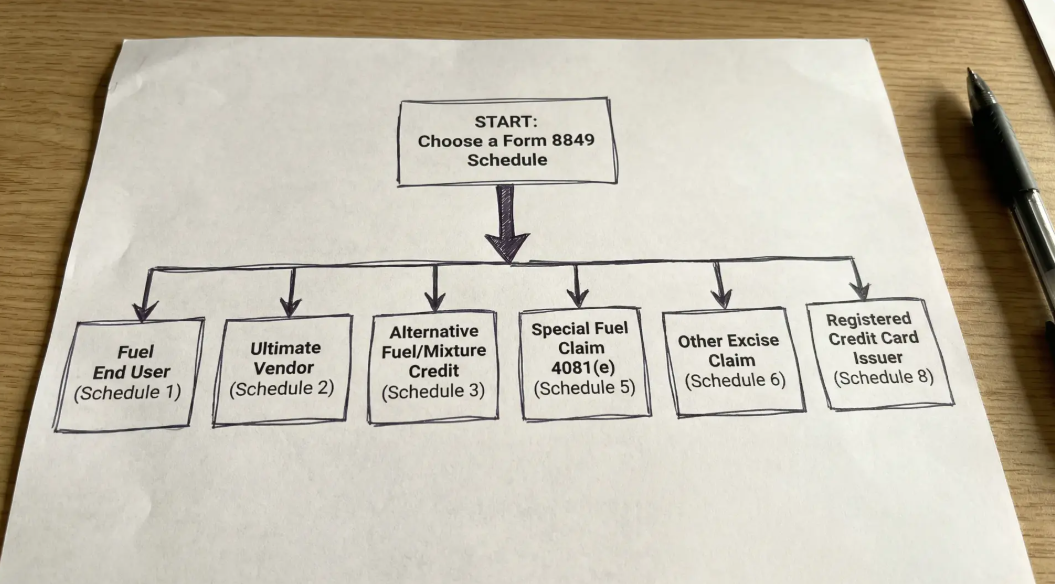
Overview of Form 8849 Schedule Types
This guide covers the most commonly used schedules:
| Form 8849 schedule | Common theme | Who typically files | Typical refund scenario (example) |
|---|---|---|---|
| Schedule 1 | Nontaxable use of fuel | Fuel purchasers/end users | Fuel used for an exempt or nontaxable purpose |
| Schedule 2 | Ultimate vendor fuel claims | Registered ultimate vendors | Vendor claims tax-paid fuel sold for qualifying uses |
| Schedule 3 | Alternative fuel and mixture credits | Alternative fuel users/blenders | Credit tied to eligible alternative fuel or mixtures |
| Schedule 5 | Section 4081(e) fuel claims | Certain registered fuel parties | Specific fuel situations allowed under 4081(e) |
| Schedule 6 | Other excise tax claims | Various claimants | Claims not covered by Schedules 1-5 or 8 |
| Schedule 8 | Credit card issuer claims | Registered credit card issuers | Refund tied to tax-paid fuel purchased via credit card |
-
Form 8849 Schedule 1
Form 8849 Schedule 1 is generally used for claims involving the nontaxable use of fuels. In many cases, this schedule applies when fuel was purchased at a tax-included price, but the fuel was ultimately used in a way that qualifies for a refund under federal excise tax rules.
Typical examples include fuel used for specific exempt purposes or in qualifying off-highway business uses (where allowed). The key idea is that the claim is tied to how the fuel was used, and the schedule is designed to capture the details the IRS needs to verify the claim.
When completing form 8849 schedule 1, accurate records matter. Keep invoices, usage logs, and any documentation that supports the nontaxable use.
-
Form 8849 Schedule 2
Form 8849 Schedule 2 is most often used for claims by registered ultimate vendors of certain fuels (commonly involving undyed diesel fuel and undyed kerosene) when the vendor is the one eligible to claim the refund under the rules.
This schedule is commonly used when a vendor sells tax-paid fuel to buyers for a qualifying use and then the vendor claims the refund rather than the end user. Whether the vendor can claim the refund depends on IRS eligibility rules and registration requirements.
If you are considering form 8849 schedule 2, review your sales documentation carefully. Vendor claims typically rely on strong transaction detail and customer eligibility support.
-
Form 8849 Schedule 3
Form 8849 Schedule 3 is associated with refund claims and credits tied to alternative fuels and certain fuel mixtures, as allowed by IRS rules for the claim period.
This schedule often comes up for businesses involved in producing, blending, or using qualified alternative fuels or mixtures where a credit is permitted. Because eligibility can be technical, it is important to use the schedule that matches your fuel activity and to follow the documentation requirements.
When filing form 8849 schedule 3, pay close attention to supporting calculations and proof of the underlying transactions (such as blending records or sales records), as required by the instructions.
-
Form 8849 Schedule 5
Form 8849 Schedule 5 is used for certain fuel refund claims tied to section 4081(e). These claims tend to be more specialized and are often filed by businesses operating within the fuel supply chain that meet the IRS requirements for the claim type.
Because Schedule 5 is tied to a specific code section and claim framework, filers should confirm they are using it for the correct situation and for the correct claim period.
If you are working with form 8849 schedule 5, rely on the official IRS guidance to confirm eligibility and keep documentation that clearly traces the tax-paid fuel and the reason a refund is being claimed.
-
Form 8849 Schedule 6
Form 8849 Schedule 6 is commonly described as the schedule for “other claims.” It is used for refund claims that do not fall under the specific fuel and credit categories covered by Schedules 1, 2, 3, and 5, and that are not filed under Schedule 8.
Businesses may use form 8849 schedule 6 for a range of excise tax refund situations, depending on what the IRS allows for the period. Schedule 6 can also require additional statements or documentation, depending on the claim.
Because Schedule 6 is broad, it is especially important to follow the schedule instructions and make sure your claim description is clear and consistent with your records.
-
Form 8849 Schedule 8
Form 8849 Schedule 8 is used in limited situations for registered credit card issuers that are eligible to claim a refund of certain excise taxes in connection with tax-paid fuel purchased through credit card transactions.
Schedule 8 is narrower than the other schedules listed above. If you believe it applies, confirm registration requirements and supporting documentation needs in the IRS instructions before filing.
How Form 8849 Schedules Relate to Form 720 Filing
It helps to separate two tasks:
- Form 720 is how you report and pay your form 720 excise tax liability for the quarter.
- Form 8849 and its schedules are how you claim certain refunds or credits when the rules allow it.
A refund claim does not replace your ongoing Form 720 Filing requirement. Many businesses still need to file Form 720 even if they expect to claim refunds later, and the IRS may compare refund claims to reported activity.
If you want background on how Form 720 works, see our guides on Form 720 filing fundamentals and excise tax basics and Form 720 excise tax categories. For timing and planning, the Form 720 due date overview is also helpful. If you need to correct a previously filed return, Form 720-X amendments may apply (see our Form 720 e-filing checklist for amendment and refund pointers).
Common Mistakes When Choosing a Form 8849 Schedule
Many Form 8849 issues are preventable. These are some of the most common problems that can slow processing or create IRS follow-up requests:
- Choosing the wrong schedule for the claim type (for example, using a purchaser schedule when a vendor schedule is required).
- Missing required details such as gallons, dates, claim period, or supporting explanations.
- Filing a claim that does not tie back to your underlying records or to related Form 720 reporting.
- Not reviewing the form 8849 instructions and any schedule-specific requirements before submitting.
Good documentation is part of accuracy. If your team is pulling together large volumes of invoices, transaction logs, and supporting files, organized summaries can make review easier, especially if a question comes up later. Some businesses use document summarization tools such as TrialBase AI for document workflows to speed up internal review, while still relying on the IRS instructions for the actual tax rules.
How efileexcise720.com Supports Form 720 Filing
eFileExcise720 is an IRS-authorized e-filing platform designed to help businesses complete Form 720 Filing online without downloading software. The service supports all Form 720 categories and provides a guided, dashboard-based filing experience.
For filers who need to make corrections, amendment support is available where applicable (for example, Form 720-X scenarios). The platform also emphasizes secure data handling and offers customer support to help users navigate the e-filing process.
Testimonials
The final person I talked to was able to really help me and stayed on the line until the issue was resolved. I was about to end the call but she convinced me that she knew what i needed to do. A very good customer service person. Superior!.
The final person I talked to was able to really help me and stayed on the line until the issue was resolved. I was about to end the call but she convinced me that she knew what i needed to do. A very good customer service person. Superior!.
The final person I talked to was able to really help me and stayed on the line until the issue was resolved. I was about to end the call but she convinced me that she knew what i needed to do. A very good customer service person. Superior!.
Frequently Asked Questions
Start Your Form 720 Filing Online
Before claiming refunds, make sure your excise tax reporting is accurate and up to date.
Start your Form 720 Filing online with eFileExcise720.