

.webp)
eFile Excise720!
What Is Federal Excise Tax and Who Needs to File Form 720?
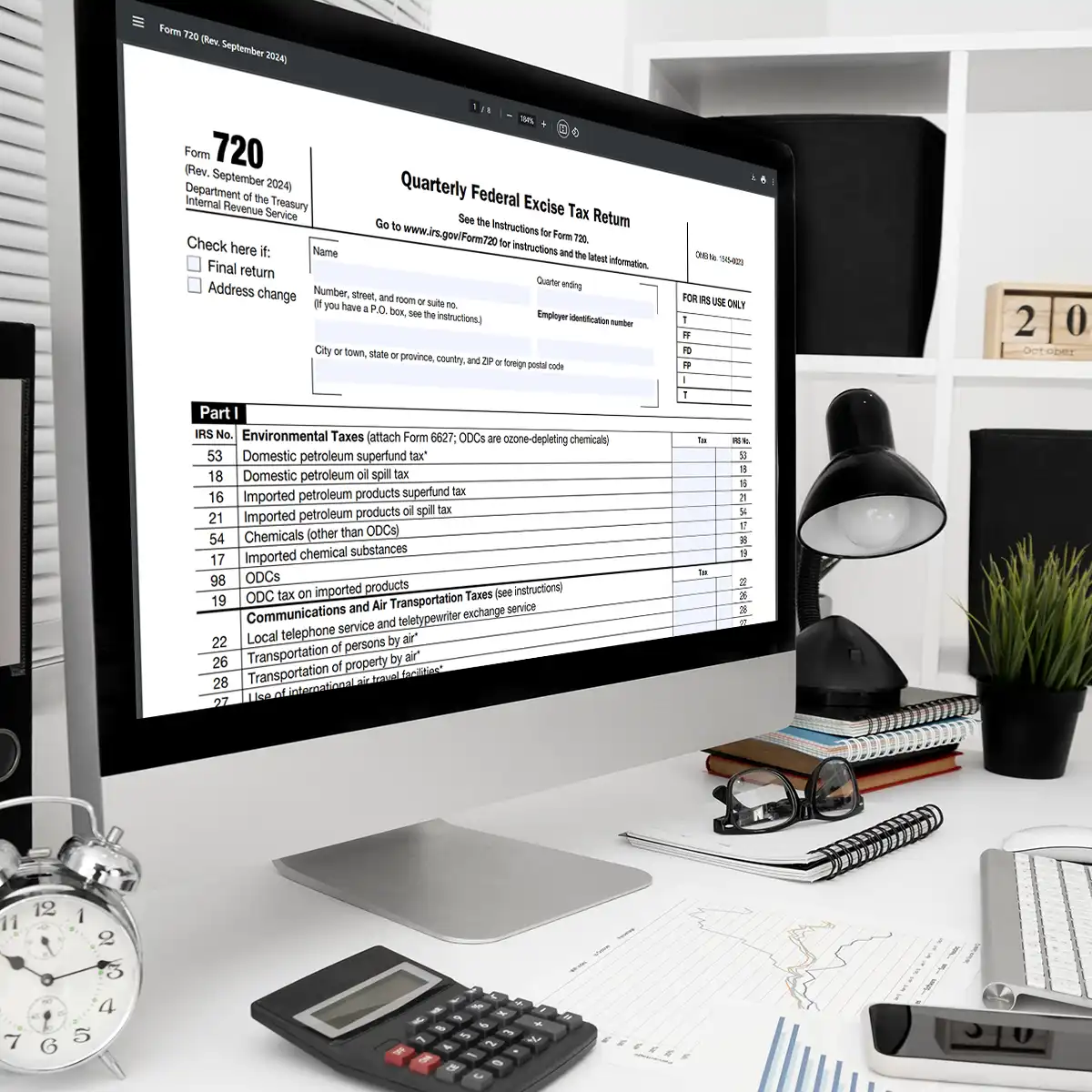
Filing Form 720 is a tax imposed by the U.S. government on specific goods, services, and activities such as fuel, air transportation, environmental products and indoor tanning services. Businesses that manufacture, sell, or are responsible for collecting these taxes must report them to the IRS using Form 720, the Quarterly Federal Excise Tax Return. Companies with excise tax liability are required to file Form 720 each quarter to report and pay these taxes. Using our online filing platform can make the process faster, more accurate, and easier for businesses to stay compliant with IRS excise tax regulations.
Whether you're managing PCORI fees for your health insurance plan or filing Form 8849 to claim a refund on excise taxes, our secure online platform streamlines every step of the federal excise tax process.
Trusted by Industry Leaders
Our Clients















Why Choose eFileExcise720?
We make federal excise tax filing simple, secure, and stress-free
SOC 2 Certified Security
Your data is protected with bank-level encryption and SOC 2 compliant infrastructure.
Real-Time IRS Updates
Get instant notifications on your filing status directly from the IRS.
Expert Support Team
Our tax specialists are available 24/5 to help you with any questions.
IRS-Authorized Provider
Officially authorized by the IRS to electronically file Form 720 and 8849.
Intuitive Dashboard
Easy-to-use interface that guides you through every step of the filing process.
10+ Years of Experience
Over a decade of building trusted tax platforms - serving thousands of US businesses with IRS-compliant e-filing solutions since day one.
How It Works
File your Form 720 in 5 simple steps
Create Account
Sign up for free in seconds
Enter Tax Data
Fill in your excise tax information
Review & Sign
Verify details and e-sign
Submit to IRS
Transmit securely to IRS
Receive Approval
Get real-time confirmation
Built for Every Business Required to File Federal Excise Tax
If your business deals in fuel, manufacturing, air transport, health plans, environmental taxes, or tanning services - you likely need to file Form 720 every quarter.
Not sure if you need to file? Read our filing eligibility guide
No Subscriptions. No Hidden Fees. Pay Only When You File.
Free to sign up. Free to prepare. Pay only when you're ready to submit.
- IRS-authorized e-file
- Built-in validation
- Real-time IRS status
- Email confirmation
- Expert support
- All schedules supported
- Fuel tax refunds
- IRS acknowledgment
- Secure filing
- Dedicated support
- Nontaxable use claims
- Easy claim entry
- Bulk claim support
- Instant calculation
- Full audit trail
Free to sign up and prepare your return. You only pay when you're ready to submit to the IRS.
Never Miss a Form 720 Filing Deadline
Form 720 is filed quarterly. Stay on top of your federal excise tax obligations.
Form 8849 - Claim Your Fuel Tax Refund
File for refunds on nontaxable fuel usage with our supported schedules
Schedule 1
Nontaxable Use of Fuels
Schedule 2
Sales by Registered Ultimate Vendors
Schedule 3
Certain Fuel Mixtures and Alternative Fuel Credit
Schedule 5
Section 4081(e) Claims
Schedule 6
Other Claims
Schedule 8
Registered Credit Card Issuers
Frequently Asked Questions
Recent Blogs
Superfund Chemical Tax: A Complete Guide to Filing Form 720
The reinstated Superfund chemical tax applies to manufacturers, producers, and importers of specific taxable chemicals and substances, reported quarterly on Form 720 alongside Form 6627. This guide covers who owes it, how the rate is calculated, semimonthly deposit rules, and the most common filing mistakes to avoid.
Read MoreVaccine Manufacturer Excise Tax: A Complete Guide to Filing Form 720
A practical breakdown of the federal vaccine manufacturer excise tax, covering who owes it, which vaccines and components are taxable, the $0.75 per-component rate and the steps for reporting and e-filing it correctly on Form 720 each quarter.
Read MoreForm 8879-EX Explained: The IRS e-File Signature Authorization for Form 720
Form 8879-EX is the IRS e-file signature authorization used alongside Form 720 to approve electronic filing of your excise tax return. This guide covers who needs to sign it, how it differs from Form 720, step by step instructions, and the most common filing mistakes to avoid.
Read More