

Form 8849 Instructions: A Complete Guide to Filing for Tax Refunds
IRS Form 8849, officially titled Claim for Refund of Excise Taxes, lets individuals and businesses request money back when certain federal excise taxes were paid but later qualify for a refund. These Form 8849 instructions explain when to use the form, which schedule to attach and how to avoid duplicate claims. If you already know you qualify and want a simpler online path, you can file Form 8849 online through eFileExcise720, an IRS-authorized e-filing platform that supports excise tax refund claims.
A clean Form 8849 filing can help reduce delays, especially when your refund depends on fuel records, vehicle mileage, prior Form 720 payments or proof that excise tax was paid. The goal is simple: document why the tax is refundable and attach the right schedule for the claim type. A Form 8849 tax refund is not automatic, so the IRS needs enough information to verify the amount and the legal basis for the claim.
What Is Form 8849?
Form 8849 is an IRS refund claim form for certain federal excise taxes. It is used when tax was paid on fuel, vehicles or other excise-taxed activity, but the taxpayer later qualifies to recover that tax under IRS rules.
The official IRS description is available on the IRS About Form 8849 page. Although many people call it tax form 8849, the form itself is only part of the filing. In most cases, you must attach one or more schedules that explain the type of refund you are claiming.
Common refund situations include fuel used for a nontaxable purpose, sales made by registered vendors to exempt buyers, certain fuel mixture claims and heavy highway vehicle use tax refunds for vehicles that were sold, stolen, destroyed or used under the mileage threshold.
The core rule is this: do not use this refund claim if you already claimed the same amount as a credit or refund on another IRS form, such as Form 720 Schedule C, Form 730, Form 2290 or Form 4136. The IRS does not allow double-claiming the same excise tax.
Form 8849 Instructions: Who Should File?
You should consider filing only if you paid a federal excise tax and meet the IRS requirements for a refund claim. Eligibility depends on the schedule, the tax period, the product or activity involved and whether the tax was already recovered elsewhere.
Typical filers include:
- Ultimate purchasers of taxed fuel used for a nontaxable purpose
- Registered ultimate vendors that sold certain fuels to exempt buyers
- Businesses claiming allowed alternative fuel or fuel mixture refunds
- Heavy vehicle owners claiming a Form 2290-related refund for sold, stolen, destroyed or low-mileage vehicles
- Registered credit card issuers that extended credit for qualifying fuel purchases by eligible government or nonprofit educational entities
If you are not sure your business fits one of those categories, review who may qualify before preparing the claim. eFileExcise720 has a helpful guide on who qualifies for a refund, including common excise tax refund scenarios.
Use the official Form 8849 instructions PDF to verify the exact schedule requirements for your claim year. Some schedules have special recordkeeping rules, registration requirements or timing limits that can affect whether the IRS accepts the claim.
When Should You File Form 8849?
Timing matters because refund claims are subject to IRS limitation periods. The Form 8849 instructions generally give a broad rule: a claim must be filed within 3 years from the date the original return was filed or 2 years from the date the tax was paid, whichever is later.
That general rule does not replace schedule-specific timing. For example, certain fuel claims may follow different periodic rules, and heavy highway vehicle use tax refunds usually depend on the event that created the refund, such as sale, theft, destruction or final mileage for the tax period.
For many approved claims, IRS processing can take about 4 to 12 weeks, though timing varies based on claim complexity, filing method, IRS workload and whether supporting information is complete. Refunds are commonly issued by paper check to the address the IRS has on file.
Do not wait until the limitation period is almost over. Claims involving fuel gallons, invoices or vehicle mileage are easier to support while the records are still organized and accessible.
How to Complete Form 8849
These Form 8849 instructions are easier to apply when you treat the form as a cover sheet plus schedule package. The main form identifies the claimant, while the attached schedule proves the refund category and amount.
If you are learning how to file Form 8849, start by matching your refund reason to the right schedule before entering dollar amounts. Many rejected or delayed claims happen because the taxpayer filled out the main form but attached the wrong schedule or left out required schedule details.
| Part of the filing | What to enter | Why it matters |
|---|---|---|
| Claimant information | Legal name, address, EIN or SSN and contact details | The IRS uses this to identify the taxpayer and mail the refund |
| Schedule selection | The schedule that matches the refund type | Claims are processed by schedule category, not by the main form alone |
| Tax period | The period when the excise tax was paid or the refund event occurred | Incorrect periods can delay matching and verification |
| Refund calculation | Gallons, tax rate, vehicle tax amount or other schedule-specific figures | The IRS needs a clear computation for the claimed amount |
| Certification | Signature, title and date | Unsigned paper claims may be rejected |
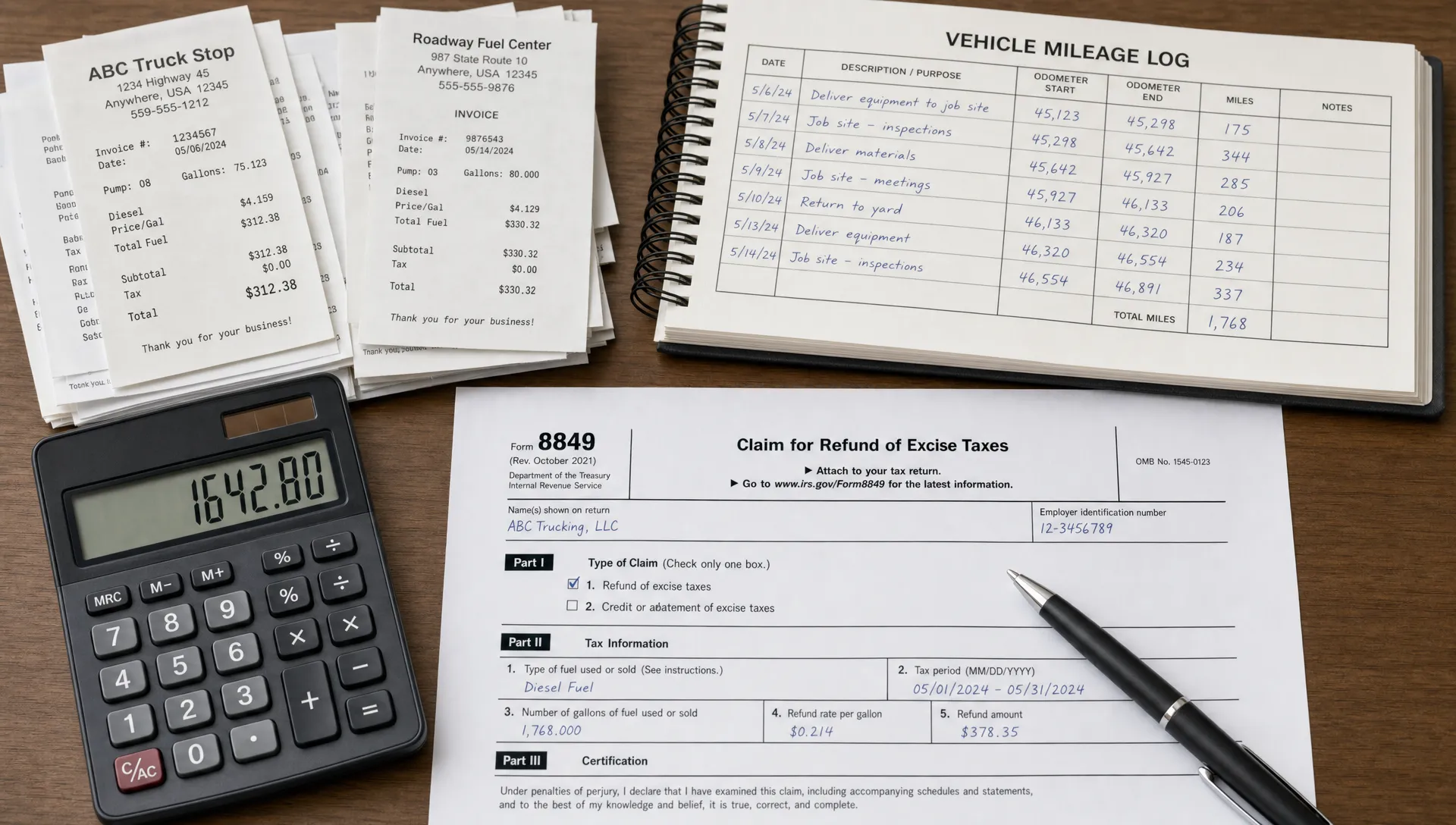
Your Form 8849 tax refund claim should also match your business records. For fuel claims, keep purchase invoices and proof that federal excise tax was included. For vehicle claims, keep the VIN, Form 2290 details, date of sale or loss and mileage support where relevant.
Businesses generally use an EIN on federal tax forms. If you need one, use the official IRS page to apply for an EIN instead of relying on unofficial services.
Understanding Form 8849 Schedules
The Form 8849 instructions PDF does not work like one universal refund worksheet. Each claim must be supported by a specific schedule. For a deeper breakdown of schedule options, review the eFileExcise720 guide to Form 8849 Schedule Types.
| Schedule | Common use | Typical claimant |
|---|---|---|
| Form 8849 Schedule 1 | Nontaxable use of fuels, such as off-highway business use, farming use or certain exports | Ultimate purchaser |
| Schedule 2, often searched as schedule 2 form 8849 | Sales by registered ultimate vendors of undyed diesel, kerosene or aviation fuel to exempt buyers | Registered ultimate vendor |
| Schedule 3 | Certain fuel mixtures and alternative fuel credit claims, where allowed for the tax period | Qualified claimant with supporting records |
| Schedule 5 | Section 4081(e) and 6435 claims, including certain fuel tax claims | Eligible fuel claimant |
| Form 8849 Schedule 6 | Other claims, including many heavy highway vehicle use tax refund claims related to Form 2290 | Vehicle owner or other eligible claimant |
| Schedule 8 | Claims by registered credit card issuers for certain fuel sales to eligible government or nonprofit educational entities | Registered credit card issuer |
For Form 8849 Schedule 1, recordkeeping is especially important because the IRS may need proof that the fuel was used for a nontaxable purpose. Keep invoices, usage logs, equipment records and any exemption support tied to the gallons claimed.
With schedule 2 form 8849 claims, the vendor's registration status and buyer eligibility matter. The claim should show that the sale met the IRS rules for a registered ultimate vendor refund.
For Form 8849 Schedule 6, heavy vehicle owners commonly claim refunds when a truck reported on Form 2290 was sold, stolen, destroyed or used 5,000 miles or less during the tax period. Agricultural vehicles generally use a 7,500-mile threshold. The IRS publishes separate Schedule 6 instructions, including the current version of the Schedule 6 instruction PDF, which should be checked before filing.
What Information Do You Need to File Form 8849?
Before you start, gather every record that supports the refund amount. Form 8849 is not just a request for money back. It is a signed claim that the taxpayer qualifies under a specific excise tax rule.
Most claimants should prepare:
- Legal business name, mailing address and EIN or SSN
- Tax period for the original payment or refund event
- Copies of related IRS filings, such as Form 720 or Form 2290, if applicable
- Fuel invoices, gallon totals, dates purchased and proof federal excise tax was paid
- Vehicle details, including VIN, taxable gross weight, mileage and sale or loss documentation
- Registration information for vendor or credit card issuer claims
- Explanation of the refund reason and calculations that match the attached schedule
If the claim relates to an excise tax originally reported on Form 720, review your original quarterly return carefully. Form 720 covers many federal excise tax categories, including certain fuel taxes, environmental taxes, communications taxes and the PCORI Fee. If the issue is simply an error on a filed Form 720, Form 720-X may be the correct correction form instead of a refund claim.
Keep supporting records even after the refund is paid. The IRS can ask for proof later, and strong documentation is the best defense against delays, denials or repayment requests.
How to Submit Form 8849
Knowing how to file Form 8849 correctly includes choosing the right submission method. You can submit electronically through an IRS-authorized e-file provider or file on paper by mailing the form and schedules to the IRS.
Electronic filing is often preferred because it reduces manual data entry errors and can move the claim into IRS processing faster. eFileExcise720 supports secure online excise tax filings with no software download and customer support for eligible refund claims.
For paper filers, tax form 8849 and each attached schedule must be mailed to the correct IRS address. For the latest mailing rules, compare these Form 8849 instructions with the current IRS version before sending anything, because addresses and procedures can change.
| Attached schedules | Mailing address shown in IRS guidance |
|---|---|
| Schedules 1 and 6 | Department of the Treasury, Internal Revenue Service, Cincinnati, OH 45999-0002 |
| Schedules 2, 5 and 8 | Department of the Treasury, Internal Revenue Service, Covington, KY 41012-0312 |
If you attach multiple schedules, verify the correct mailing rule for that combination using the current IRS materials. Send copies, not your only original business records, and keep proof of mailing for your files.
Common Form 8849 Filing Mistakes to Avoid
Even valid refund claims can be slowed down by small errors. Review the claim before submitting it, especially if your refund depends on fuel gallons, heavy vehicle mileage or a prior excise tax return.
Common mistakes include:
- Claiming the same excise tax amount on more than one IRS form
- Using the refund claim to correct a Form 720 reporting error that should be handled on Form 720-X
- Attaching the wrong schedule for the refund category
- Missing EIN, tax period, VIN, fuel gallon totals or vendor registration details
- Rounding or estimating figures without records to support the calculation
- Mailing to the wrong IRS address for the schedule attached
- Forgetting to sign and date a paper claim
The most serious mistake is double-claiming. If you have already claimed the same amount as a credit on Form 720 Schedule C, Form 4136, Form 730 or Form 2290, do not claim it again here.
Form 8849 vs. Form 720: What Is the Difference?
Form 720 and Form 8849 often appear together in excise tax compliance, but they serve opposite functions. Form 720 is mainly used to report and pay federal excise taxes. Form 8849 is used to request a refund of certain excise taxes that were already paid.
| Form | Main purpose | When it is used |
|---|---|---|
| Form 720 | Quarterly Federal Excise Tax Return | To report and pay excise taxes such as fuel, environmental, communications and PCORI-related taxes |
| Form 8849 | Claim for Refund of Excise Taxes | To claim a refund when excise tax was paid but is refundable under IRS rules |
| Form 720-X | Amended Quarterly Federal Excise Tax Return | To correct certain errors on a previously filed Form 720 |
A simple way to separate them is to ask what you are trying to do. If you are reporting current excise tax liability, Form 720 is usually the starting point. If you already paid tax and now qualify for a refund, Form 8849 may apply. If you made a mistake on Form 720, review whether Form 720-X is required.
Frequently Asked Questions
Do I need to fill out form 8849? You need to fill it out only if you paid a federal excise tax and qualify for a refund under one of the IRS schedule categories. If you already claimed the amount as a credit or refund elsewhere, do not claim it again.
What is form 8849 used for? It is used to claim refunds of certain federal excise taxes, including qualifying fuel tax refunds and certain heavy highway vehicle use tax refunds.
Can I file form 8849 online? Yes. Eligible claims can be filed online through an IRS-authorized e-file provider. Online filing can reduce paperwork and help avoid common manual entry errors.
Who is required to file form 8949? Form 8949 is different from Form 8849. Form 8949 is generally used to report sales and exchanges of capital assets, such as stocks or crypto transactions, while Form 8849 is for excise tax refund claims.
Where to mail IRS form 8849? The mailing address depends on the schedules attached. Schedules 1 and 6 are generally mailed to Cincinnati, OH, while Schedules 2, 5 and 8 are generally mailed to Covington, KY. Always confirm with the current IRS guidance before mailing.
Who is required to pay federal excise tax? Businesses and individuals may owe federal excise tax when they engage in taxable activities or sell taxable products covered by IRS rules, such as certain fuels, heavy vehicles, indoor tanning services, communications services or PCORI-related obligations.
File Your Refund Claim With Less Guesswork
Form 8849 can be straightforward when the refund reason, schedule and records all match. It becomes frustrating when claimants use the wrong schedule, miss the filing deadline or claim a credit that was already taken somewhere else.
If your business handles excise tax reporting or refund claims, eFileExcise720 can help simplify the process with IRS-authorized e-filing, secure data handling, no software download and support for Form 720, Form 720-X, Form 8849 and Form 8849 schedules. Prepare your records, confirm your eligibility and file with confidence.