

How to E-File Coal Excise Tax on Form 720 in 5 Minutes
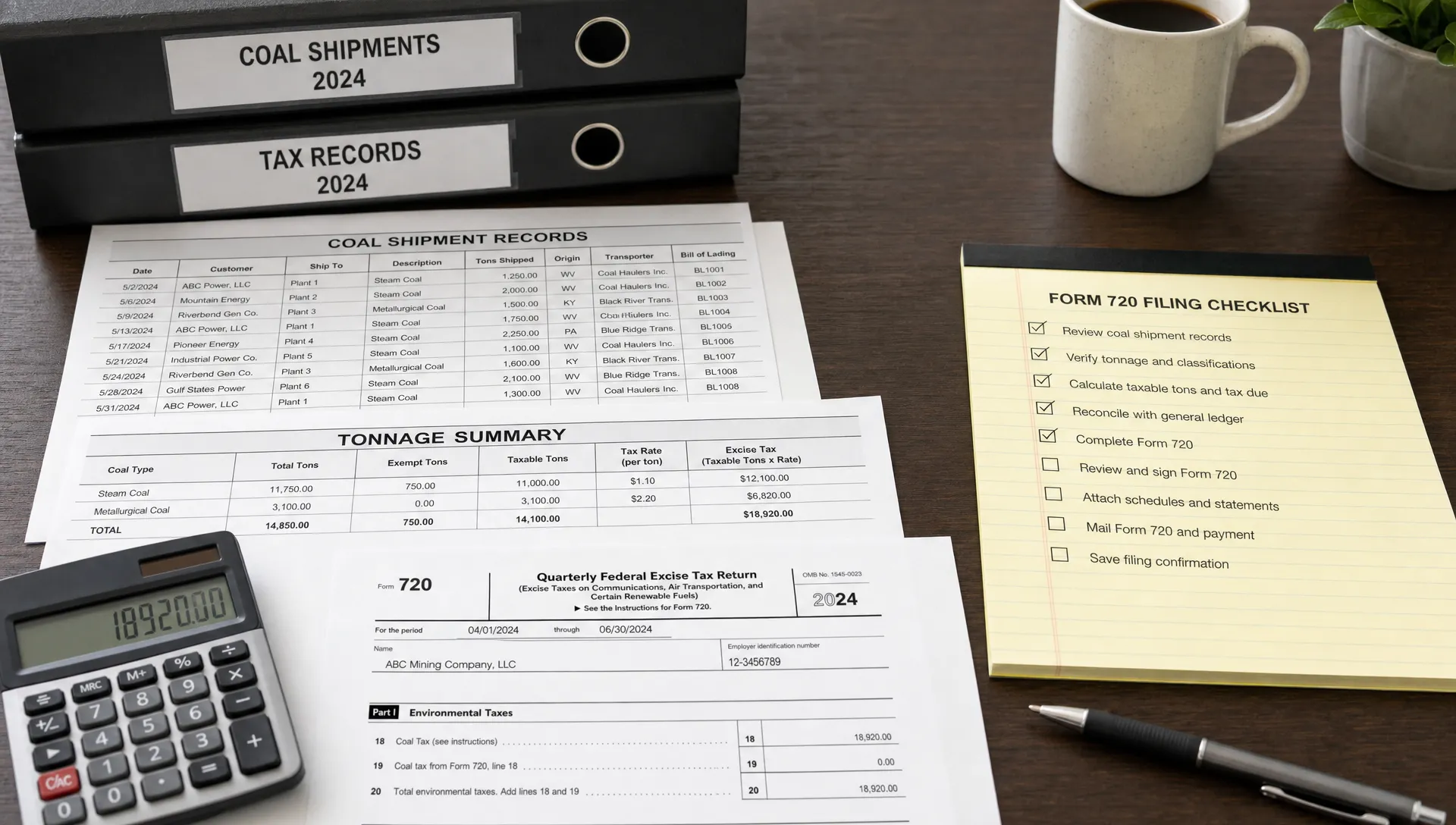
If you produce coal in the United States, you can e-file Coal Excise Tax on IRS Form 720 in about 5 minutes once your tonnage, sales price and exemption records are ready. The filing itself is usually the easy part. The time saver is knowing which numbers belong on the return before you open the portal.
This guide is written for coal producers, accounting teams and tax preparers who need a practical path to file Form 720 online without sorting through unrelated excise tax categories. It covers what the tax is, 2026 filing dates, current rates, common exemptions and the fastest way to complete the return through an IRS-authorized e-file provider.
Quick answer for coal producers
| Filing question | Practical answer |
|---|---|
| Who usually files? | A U.S. coal producer that first sells or uses mined coal. |
| What form is used? | IRS Form 720, the Quarterly Federal Excise Tax Return. |
| What records do you need? | Tons sold or used, mining method, sales price, exempt shipments and prior deposits. |
| What rate applies? | $1.10 per ton for underground-mined coal or $0.55 per ton for surface-mined coal, subject to a 4.4% sales price cap. |
| What is exempt? | Lignite and coal mined in the United States specifically for export are generally exempt. |
| How fast can e-filing be? | Around 5 minutes if the data is complete before you start. |
What is Coal Excise Tax?
If you came here asking what is coal excise tax, the short answer is this: it is a federal excise tax paid by U.S. coal producers when they first sell or use coal mined in the United States. It is not a retail sales tax charged to a household customer at checkout. It is a producer-level tax tied to the mining and first sale or use of coal.
The federal coal excise tax is imposed under Section 4121 of the Internal Revenue Code. According to the U.S. Department of the Interior's Natural Resources Revenue Data, the revenue supports the Black Lung Disability Trust Fund, which helps provide medical and disability benefits to coal miners disabled by black lung disease and eligible dependents.
The federal coal excise tax is collected by the IRS and reported on Form 720. In practice, that means a coal producer needs to determine taxable tons by mining method, apply the rate and sales price cap, account for exemptions and file the quarterly return on time.
A simple way to think about it: Coal Excise Tax applies when taxable coal moves from the producer into sale or use. The reporting obligation follows the activity, not the size of the company.
What is Form 720 and why coal producers use it
If your broader question is what is Form 720, it is the IRS return used to report many federal excise taxes. The official IRS name is the Quarterly Federal Excise Tax Return. Coal is one category on the return, but Form 720 also covers other excise tax areas such as fuel, environmental taxes, communications, air transportation, indoor tanning and the PCORI fee.
The IRS tax Form 720 is filed quarterly, not annually. A coal producer may have a relatively short coal section to complete, but the return still needs accurate business information, the right reporting period and proper payment or deposit treatment.
The practical answer to what is Form 720 for coal businesses is simple: it is the federal return that turns your taxable tons and sales price calculations into an IRS filing record. If you want a broader walkthrough before focusing on coal, eFileExcise720 explains how to file IRS Form 720 online through its e-filing platform.
People often search for IRS tax form 720 when they need the correct excise tax return, but not every category on the form applies to every business. Coal producers should focus on the coal section, then review whether they also have other liabilities for the same quarter.
Coal Excise Tax 2026 rates, due dates and exemptions
For coal excise tax 2026 planning, the key numbers remain the statutory rates that apply by mining method, subject to the sales price cap. Always confirm the current IRS guidance for the tax year before filing because form layouts, line references and payment instructions can change.
| Coal type | Rate | Sales price cap |
|---|---|---|
| Underground-mined coal | $1.10 per ton | Tax cannot exceed 4.4% of the coal's sales price. |
| Surface-mined coal | $0.55 per ton | Tax cannot exceed 4.4% of the coal's sales price. |
| Lignite | Generally not subject to the tax | Confirm classification in your records. |
| U.S.-mined coal for export | Generally exempt | Keep export documentation. |
The 4.4% cap matters when coal sells at a lower price. You calculate the per-ton amount and compare it with 4.4% of the sales price, then use the lower result. This is one of the most common places where filing errors happen.
For coal excise tax 2026 returns, Form 720 due dates follow the normal quarterly schedule. If a due date falls on a weekend or federal holiday, the deadline usually moves to the next business day.
| Reporting quarter | Period covered | 2026 Form 720 due date |
|---|---|---|
| Q1 | January 1 to March 31, 2026 | April 30, 2026 |
| Q2 | April 1 to June 30, 2026 | July 31, 2026 |
| Q3 | July 1 to September 30, 2026 | November 2, 2026 |
| Q4 | October 1 to December 31, 2026 | February 1, 2027 |
Because Form 720 is a quarterly federal excise tax return, the return due date is not the only date to watch. Certain excise taxes may require deposits before the return is filed. Many businesses use EFTPS for federal tax deposits. Do not assume IRS Direct Pay supports every excise payment scenario, and check the current form 720 instructions for the payment method that applies to your business.
What to have ready before you e-file
Before you start, gather the information that usually slows down an otherwise quick online filing. You do not want to stop halfway through the return to confirm whether coal was underground-mined, surface-mined, exempt or subject to the sales price cap.
Have these items ready:
- EIN, legal business name and address for the filing entity.
- Reporting quarter and tax year.
- Tons of underground-mined coal sold or used during the quarter.
- Tons of surface-mined coal sold or used during the quarter.
- Sales price records needed for the 4.4% limitation.
- Documentation for lignite or export exemptions.
- Records of any deposits already made for the quarter.
If your business does not yet have an employer identification number, you can apply for an EIN through the IRS before filing. If you already have one, make sure it matches the entity that produced and sold or used the coal.
For line-by-line support, review the official IRS guidance and this plain-English guide to Form 720 IRS instructions. The form 720 instructions are especially helpful when confirming where a category belongs and how payment rules apply.
How to e-file Coal Excise Tax in 5 minutes
The 5-minute workflow assumes your records are already prepared. If you still need to reconcile invoices, production logs or export documentation, do that first. Once your numbers are clean, the filing process is straightforward.
| Time | What to do | Why it matters |
|---|---|---|
| Minute 1 | Create or access your eFileExcise720 account. | Account creation is free, and no software download is needed. |
| Minute 2 | Choose Form 720 and select the correct quarter. | The quarter drives the filing period, deadline and return record. |
| Minute 3 | Enter coal activity by mining method. | Underground-mined and surface-mined coal use different rates. |
| Minute 4 | Review the Coal Excise Tax total and payment details. | This is where the 4.4% sales price cap and deposits should be checked. |
| Minute 5 | Transmit the return and save your confirmation. | E-filing gives you a filing record without mailing a paper return. |
When IRS Form 720 is filed online through eFileExcise720, you can use simple dashboard navigation, secure data handling and personalized customer support if you need help during the process. The platform supports Form 720 categories, amendments through Form 720-X and Form 8849 claims support, which can be useful for businesses that handle multiple excise tax matters.
E-filing vs paper filing for coal producers
A form 720 fillable PDF can help you preview the return, but it is not always the fastest way to file. Paper filing can lead to extra questions such as where to send Form 720, where to mail Form 720, which Form 720 mailing address applies and whether Form 720-V is needed for a check or money order payment.
Form 720 online filing removes much of that friction. You enter the information digitally, review the return and transmit it through an IRS-authorized e-file provider. For a coal producer working close to a deadline, excise tax e-filing can reduce the risk of mailing delays and make it easier to keep proof of submission.
If you are comparing related excise categories, eFileExcise720 also provides separate resources for Manufacturers Tax filing and Fuel Excise Tax. Those categories are separate from coal, but many accounting teams handle more than one excise tax workflow in the same quarter.
Common filing mistakes to avoid
Coal Excise Tax mistakes are usually recordkeeping mistakes, not form complexity problems. The return depends on the numbers behind it.
| Mistake | Why it creates risk | How to avoid it |
|---|---|---|
| Combining underground and surface tons | The rates are different. | Track tons by mining method before preparing the return. |
| Ignoring the 4.4% cap | The tax may be overstated when sales prices are low. | Compare the per-ton rate with the sales price limitation. |
| Reporting exempt coal as taxable | Lignite and qualifying exports may be exempt. | Keep classification and export records with the return file. |
| Confusing deposits with return filing | Paying does not always replace filing. | Confirm both deposit obligations and Form 720 filing deadlines. |
| Using the wrong quarter | The IRS record will not match your activity period. | Check the quarter before transmitting the return. |
If a filed return later needs correction, Form 720-X may be used for certain amendments. That is separate from the original quarterly filing, so keep copies of the original return, supporting schedules and confirmation records.
Where the PCORI fee fits, and why it is different
Some businesses land on coal filing pages after searching for IRS Form 720 PCORI, PCORI fee Form 720 or PCORI form 720. That is understandable because the PCORI fee is also reported on Form 720, but it is not the same tax as coal.
The PCORI fee generally applies to certain self-insured health plans and specified health insurance policies. Coal tax applies to coal producers when taxable coal is first sold or used. If your business needs help with that separate filing category, see the IRS Form 720 PCORI fee filing page for a more relevant workflow.
Frequently Asked Questions
What is coal excise tax in simple terms?
It is a federal tax on taxable coal when a U.S. producer first sells or uses mined coal. It is reported on Form 720 and helps fund the Black Lung Disability Trust Fund.
Does coal excise tax 2026 use a different return?
No. For 2026, coal producers generally continue to report the tax on IRS Form 720. Always review the current IRS instructions for that filing year before submitting.
Who has to pay an excise tax?
A business has to pay an excise tax when it engages in a taxable activity listed under federal excise tax law. For coal, that is generally the producer that first sells or uses taxable coal.
What is the difference between a tariff and an excise tax?
A tariff is generally a tax on imported goods. An excise tax is generally a tax on a specific product, service or activity, such as fuel, coal, indoor tanning or certain health policy fees.
Where to file Form 720 for coal?
You can file electronically through an IRS-authorized e-file provider such as eFileExcise720. Paper filers must follow the current IRS Form 720 mailing instructions and payment voucher guidance.
Can I file Form 720 online if I only have coal activity?
Yes. You do not need to have every Form 720 category. You can report the coal category that applies to your business and leave unrelated categories out.
Ready to e-file your coal return?
If your tonnage, sales price and exemption records are ready, you can complete the filing quickly with eFileExcise720. The platform is IRS-authorized, requires no software download, supports secure online filing and offers customer support when you need help.
Start by choosing the correct quarter, entering your coal activity and reviewing the return before transmission. A clean 5-minute filing starts with clean records, and e-filing helps you finish without the paper mailing process.