

Tanning Bed Prices and the 10% Indoor Tanning Tax: Form 720 Guide
Tanning bed prices can mean two different things: the upfront cost of buying a residential or commercial unit and the amount a salon charges a customer for UV indoor tanning. That distinction matters because the 10% federal indoor tanning excise tax is reported on IRS Form 720 by businesses that provide taxable UV tanning services, not by someone who simply buys a unit for personal use.
If you came here asking how much does a tanning bed cost, the answer depends on lamp count, voltage, build quality and whether the unit is meant for home or commercial use. If your question is how much for tanning bed sessions at a salon, the 10% federal tax may affect what the customer pays at checkout. A customer may call the UV unit a tan bed, but the tax rules focus on the service being sold.
What Are Tanning Bed Prices?
Tanning bed prices typically range from $1,700 to $3,500 for residential models, while commercial-grade systems generally cost between $4,500 and $7,000 or more. Entry-level home units often run on standard 110V or 120V household outlets. Higher-output commercial units, stand-up booths and hybrid red-light systems may require 220V or 240V wiring, stronger ventilation and a more planned installation.
So how much does a tanning bed cost in practical terms? For home use, smaller 16 to 24 lamp beds are usually the most affordable. Larger 32 lamp systems, facial lamps and more durable acrylics raise the price. For a business, the equipment budget also includes electrical work, room layout, timer systems, replacement lamps, protective eyewear, cleaning supplies, maintenance and insurance.
| Category | Typical purchase range | Common use case | Key cost factor |
|---|---|---|---|
| Residential 16 to 24 lamp bed | $1,700 to $2,600 | Home use, lower session volume | Often 110V or 120V plug-in setup |
| Residential 32 lamp bed | $2,500 to $3,500 | Home users wanting stronger output | More lamps, facial options and larger frame |
| Basic vertical or booth unit | $3,500 to $5,000 | Small salon, gym or space-limited room | Stand-up design and higher output |
| Commercial lay-down or hybrid unit | $4,500 to $7,000+ | High-volume tanning business | 220V/240V wiring, short sessions and durability |
| Indoor tanning lotions and accelerators | $10 to $25 per bottle for many retail options | Add-on retail sale | Brand, bronzing formula and bottle size |
Searches for how much for tanning bed often mix equipment shopping with salon service pricing. That can be confusing because buying a bed for home use is not the same as selling ultraviolet tanning sessions to customers. The federal indoor tanning tax applies to taxable services, not to the purchase price of a bed itself.
Is There a Tax on Indoor Tanning Services?
Yes. The federal indoor tanning tax is a 10% excise tax on amounts paid for indoor tanning services that use ultraviolet lamps. The rule is found in Internal Revenue Code section 5000B, and the IRS explains the filing obligation through its Indoor Tanning Services Tax Center.
The tax was created under the Affordable Care Act and took effect in 2010. It is separate from state sales tax. If a state or city also taxes personal care services, the business may need to handle that separately through state or local tax systems.
If you are researching terms like indoor tanning tax California, indoor tanning tax Massachusetts or indoor tanning tax 2022, remember that the federal excise tax is a nationwide rule for applicable periods. State rules can vary, and federal repeal proposals do not change a filing obligation unless they become law and apply to the quarter you are filing. The Tanning Tax Repeal Act of 2025 and similar proposals are worth monitoring, but businesses should rely on current IRS guidance for the filing period in question.
How Does the Indoor Tanning Tax Affect Tanning Bed Prices?
For salon customers, the 10% tax increases the amount paid for taxable UV tanning services. If a salon charges $20 for a UV session, the federal indoor tanning tax is $2. The customer may see a total of $22 before any separate state or local sales tax, depending on how the business presents its receipts and how local sales tax rules apply.
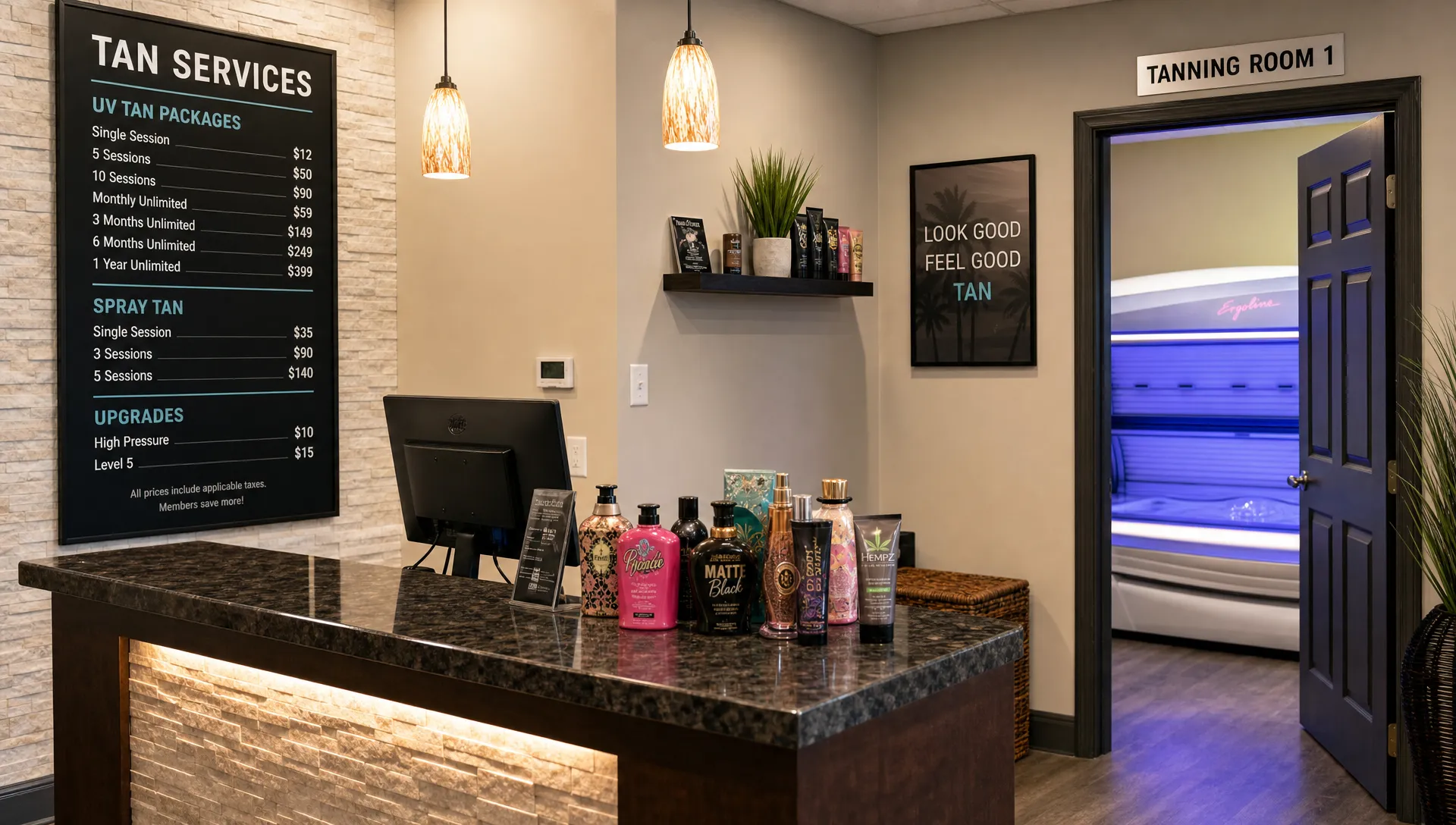
For service menus, tanning bed prices should be displayed clearly so customers understand what is being charged for the UV tanning service and what is being collected as tax. If a business advertises packages, memberships or bundled wellness services, clear allocation matters even more.
For equipment buyers, the federal indoor tanning tax generally does not add 10% to the retail purchase of the machine. Regular sales tax, freight, installation and electrical work may still apply, but the federal Form 720 tanning tax is tied to selling ultraviolet indoor tanning services to customers.
Who Pays the Indoor Tanning Tax?
The customer pays the 10% tax as part of the payment for taxable indoor tanning services. The business providing the service collects it and remits it to the IRS on Form 720.
That collection role is important. If a tanning salon, spa, gym or similar business provides taxable UV tanning and fails to collect the tax, the IRS can still look to the business for the amount due. Good records protect the business by showing the taxable service revenue, the tax collected, exempt services and any bundled package allocations.
A simple checkout workflow helps. The receipt should separate the UV tanning charge from the federal excise tax when possible. Staff should also know the difference between UV tanning, spray tanning and medical phototherapy so the business does not overcollect or undercollect.
How Is the Tanning Tax Reported on Form 720?
The indoor tanning tax is reported quarterly on IRS Form 720, Quarterly Federal Excise Tax Return. Indoor tanning services are generally identified on Form 720 as IRS No. 140. The business reports the tax for the quarter, signs the return and submits payment according to IRS rules.
The standard Form 720 due dates are based on calendar quarters:
| Quarter | Period covered | Typical due date |
|---|---|---|
| First quarter | January 1 to March 31 | April 30 |
| Second quarter | April 1 to June 30 | July 31 |
| Third quarter | July 1 to September 30 | October 31 |
| Fourth quarter | October 1 to December 31 | January 31 of the following year |
If a due date falls on a weekend or federal holiday, the deadline usually moves to the next business day. Businesses should confirm the current year's deadline before filing.
If you want a broader explanation of how the quarterly return works, this guide on what Form 720 is used for explains how different federal excise taxes fit into the same return.
Businesses that prefer to avoid paper forms can use Indoor Tanning Excise Tax Filing Online through eFileExcise720. The platform is IRS-authorized, requires no software download and supports secure online filing for Form 720 categories, including indoor tanning excise tax.
Are All Tanning Services Subject to the 10% Tax?
No. The tax applies to ultraviolet indoor tanning services. It does not apply to every product or service offered by a salon.
| Service or charge | Usually subject to 10% federal indoor tanning tax? | Why it matters |
|---|---|---|
| UV lay-down tanning session | Yes | Customer pays for exposure to UV lamps |
| UV stand-up tanning booth | Yes | Still an indoor UV tanning service |
| Monthly UV tanning package | Yes, to the taxable UV portion | Package revenue must be tracked |
| Spray tan or sunless tan | No | No ultraviolet lamp exposure |
| Tanning lotion sold separately | No under the federal tanning tax | It is a product sale, not the UV service |
| Medical phototherapy by a licensed medical professional on-site | Generally exempt | Treated differently from cosmetic tanning |
| Qualified fitness facility access where tanning is incidental and not separately charged | Generally not taxable | The IRS has special rules for qualified fitness facilities |
Bundled packages need attention. If a salon sells a package that includes UV tanning, spray tanning and retail products, the business should make a reasonable allocation and keep documentation. The taxable part is the amount paid for UV indoor tanning services.
How to Calculate the Indoor Tanning Tax
The basic formula is simple:
Here are common examples:
| Customer purchase | Taxable UV amount | 10% federal tax | Customer total before other taxes |
|---|---|---|---|
| Single UV session | $20 | $2 | $22 |
| UV session package | $75 | $7.50 | $82.50 |
| Monthly UV membership | $100 | $10 | $110 |
| Bundle with $30 UV tanning and $40 spray tanning | $30 | $3 | $73 |
This is why tanning bed prices on a salon menu should be tied to clean point-of-sale categories. The cleaner the categories, the easier the quarterly Form 720 filing becomes.
For example, a salon that collects $8,000 in taxable UV tanning service charges during a quarter would calculate $800 in federal indoor tanning excise tax. If the salon also sold $2,000 in lotions and $3,000 in spray tans, those amounts would generally not be part of the federal UV tanning tax base.
Do Tanning Businesses Need to File Form 720?
Yes, businesses that provide taxable ultraviolet indoor tanning services generally need to file Form 720 for the applicable quarter and remit the tax collected. That includes tanning salons and other businesses that separately charge customers for UV indoor tanning.
Before filing, a business should have an employer identification number. If you do not have one yet, you can apply for an EIN through the IRS.
A practical filing checklist includes the following:
- Total taxable UV tanning service revenue for the quarter
- Amount of federal indoor tanning tax collected from customers
- Separate totals for spray tanning, product sales and other non-taxable revenue
- Documentation for bundles, discounts and memberships
- Business legal name, EIN and contact details
- Any prior-quarter corrections that may require an amended filing
If a previously filed excise tax return needs correction, Form 720-X may be required. If a business overpaid certain excise taxes and qualifies for a claim, Form 8849 may be relevant. Those situations depend on the facts, so review the IRS instructions or work with a qualified tax professional.
For day-to-day compliance, the best approach is to track taxable UV tanning revenue as it happens instead of reconstructing it at the end of the quarter. A clean point-of-sale setup can save hours when Form 720 is due.
Tanning Bed Prices and Indoor Tanning Tax FAQs
Is there still a tax on tanning? The IRS describes a 10% federal excise tax on ultraviolet indoor tanning services for applicable taxable periods. Because tax law can change, especially when repeal bills are introduced, confirm the current IRS rules for the quarter you are filing.
What is a tan tax? A tan tax is the common name for the 10% federal excise tax on indoor UV tanning services. Customers pay it when they buy taxable UV tanning, and the business reports it on Form 720.
What is the average cost of tanning? Pricing varies by market, salon level, session length and package structure. For people asking how much for tanning bed access, a single salon session is priced differently from a monthly package or the purchase of a home unit.
Are tanning beds illegal now? No, tanning beds are not federally illegal for adults. Some states and local jurisdictions restrict minors from using indoor tanning services, and businesses should follow all federal, state and local rules. A tan bed itself is not federally banned, but UV tanning services may be regulated and taxed.
Do home tanning bed owners file Form 720? Generally, no. Buying a home unit for personal use does not make you a Form 720 indoor tanning tax filer. The filing obligation applies to businesses charging customers for taxable UV indoor tanning services.
Does the 10% tax apply to spray tans? No. Spray tans and sunless tanning services do not use ultraviolet lamps, so they are not subject to the federal indoor tanning excise tax.
Does sales tax replace the federal indoor tanning tax? No. State or local sales tax is separate from the federal 10% excise tax. A business may need to collect both depending on its location and the service sold.
File Indoor Tanning Excise Tax With Less Guesswork
Indoor tanning businesses have enough to manage without letting quarterly excise tax filing become a last-minute scramble. eFileExcise720 helps businesses e-file Form 720 online through an IRS-authorized platform with secure data handling, simple dashboard navigation and customer support.
If your business provides taxable UV indoor tanning services, keep your revenue categories clean, calculate the 10% tax by quarter and file on time. A little structure at checkout makes Form 720 much easier when the deadline arrives.