

What Is a Form 720 Used For? A Complete Guide to Quarterly Excise Tax Filing
What Is a Form 720 Used For? U.S. businesses use IRS Form 720 to report and pay federal excise taxes on specific goods, services and business activities. It is not an income tax return. It is a quarterly federal excise tax return for taxes that often apply to fuel, heavy vehicles, environmental products, air transportation, indoor tanning and certain health plan fees.
In plain language, Form 720 tells the IRS what excise tax your business owes for the quarter, how much has already been deposited or paid and whether any additional balance is due. If you searched what is Form 720 because you received a notice, started selling taxable products or need PCORI reporting for a health plan, the key question is whether your business activity matches one of the taxable categories listed in the current return and instructions.
The IRS maintains the official return and updates on the IRS Form 720 page. Businesses should always use the current year version because rates, addresses and instructions can change.
What Is a Form 720 Used For in Plain English?
What Is a Form 720 Used For at a practical level? It is used to calculate, report and pay federal excise taxes. Excise taxes are different from income taxes because they are tied to a specific product, service or transaction rather than the overall profit of a business.
For example, a company may owe excise tax because it sells taxable fuel, manufactures certain taxable goods, sells heavy highway vehicles at retail or sponsors a self-insured health plan subject to the PCORI fee. The business reports those liabilities on Form 720 for the correct quarter, then makes deposits or a final payment according to IRS rules.
The Form is officially called the Quarterly Federal Excise Tax Return. That name matters because many businesses overlook it when they file annual income tax returns, payroll tax returns or sales tax returns. Form 720 is separate from state sales tax, separate from income tax and separate from payroll forms like IRS Form 943, which is used for agricultural employer payroll taxes.
Who needs to file Form 720?
A business generally needs to file Form 720 if it is liable for one or more federal excise taxes listed on the return. Liability depends on the activity, not the business structure. A corporation, partnership, sole proprietorship, nonprofit organization or LLC may need to file if it sells, manufactures or provides taxable items or services.
You may need to review Form 720 if your business does any of the following:
- Sells or uses taxable fuels such as gasoline, diesel or kerosene
- Manufactures or sells certain taxable products, including tires, coal or gas guzzler vehicles
- Sells heavy trucks, trailers or tractors at retail
- Provides indoor tanning services
- Handles air transportation or certain communication services
- Sponsors a self-insured health plan, health reimbursement arrangement or similar plan that may owe PCORI fees
- Deals with environmental taxes, oil spill liability taxes or ozone-depleting chemicals
A simple rule helps: if your business activity appears in the Form 720 tax categories, do not assume your income tax filing covers it. Check the current Form 720 instructions, confirm the tax base and rate, then file for the quarter if tax is due.
What Is a Form 720 Used For by Tax Category?
The excise tax Form 720 can feel broad because it covers several unrelated industries. The table below summarizes the major categories most business owners encounter.
| Form 720 category | Common examples | Typical filer |
|---|---|---|
| Fuel taxes | Gasoline, diesel fuel, kerosene, alternative fuels | Fuel retailers, producers, importers or certain users |
| Environmental taxes | Petroleum, oil spill liability, ozone-depleting chemicals | Manufacturers, importers or businesses handling covered substances |
| Retail taxes | Heavy trucks, trailers and tractors | Dealers or sellers of taxable heavy vehicles |
| Communications and air transportation | Air tickets and certain aviation services | Airlines, ticket sellers or service providers |
| Manufacturer taxes | Tires, coal, gas guzzler automobiles and vaccines | Manufacturers, producers or importers |
| Health-related fees | Patient-Centered Outcomes Research Institute fees | Self-insured health plan sponsors and certain insurers |
| Indoor tanning services | Taxable indoor tanning services | Tanning salons or businesses offering tanning services |
| Foreign insurance taxes | Certain policies issued by foreign insurers | Policyholders, brokers or related responsible parties |
The simplest answer to What Is a Form 720 Used For is this: it matches a taxable activity to the correct IRS excise tax line, calculates the liability and reports the amount for the quarter. For fuel or manufacturer obligations, this excise tax Form 720 workflow may involve more detailed records, product volumes, tax rates and deposit timing.
Businesses with fuel activity can review dedicated Fuel Excise Tax filing guidance, and businesses that produce or sell taxable manufactured goods can review Manufacturers Tax filing resources for category-specific help.
Form 720 due dates for 2026
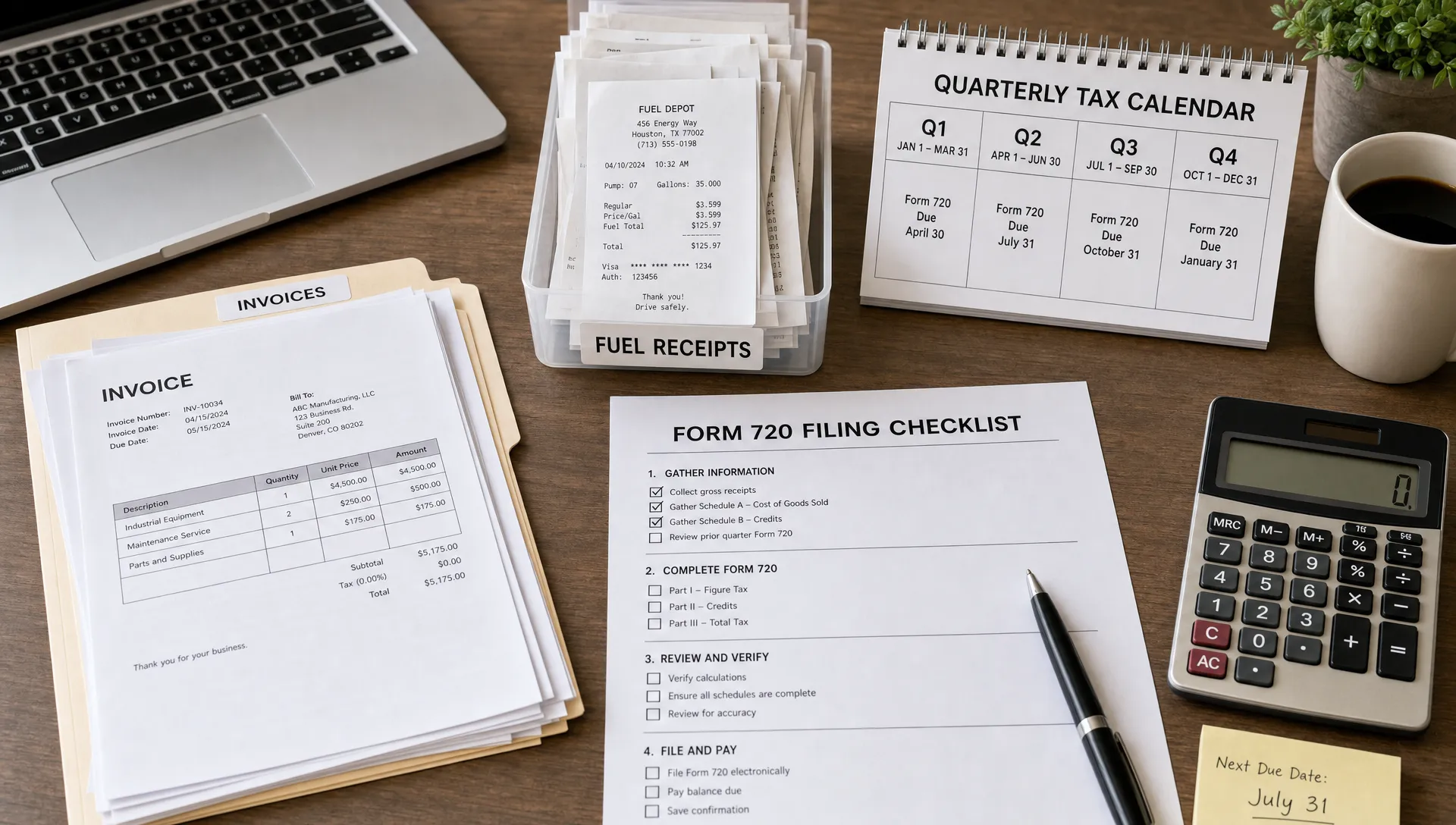
Because Form 720 is a quarterly federal excise tax return, most filers report activity four times per year. The return is generally due by the last day of the month following the end of the quarter. If the due date falls on a weekend or federal holiday, the IRS usually moves the deadline to the next business day.
| 2026 quarter | Tax period covered | Regular due date | 2026 filing deadline |
|---|---|---|---|
| First quarter | January 1 to March 31, 2026 | April 30 | April 30, 2026 |
| Second quarter | April 1 to June 30, 2026 | July 31 | July 31, 2026 |
| Third quarter | July 1 to September 30, 2026 | October 31 | November 2, 2026 |
| Fourth quarter | October 1 to December 31, 2026 | January 31 | February 1, 2027 |
These are return due dates. Some excise taxes also require deposits before the quarterly return is filed. That distinction is important because a business can file the return on time and still face a deposit penalty if required deposits were late or short.
How a form 720 payment works
A form 720 payment is separate from submitting the return. Filing reports the liability. Payment satisfies the tax due. Depending on the tax type and amount, a business may need to make deposits during the quarter through the Electronic Federal Tax Payment System, better known as EFTPS.
Many filers search for EFTPS form 720 because they assume EFTPS files the return. It does not. EFTPS is a payment system. You still need to file Form 720 by the deadline, even if you already made deposits through EFTPS.
Common payment scenarios include quarterly payment with the return, required deposits during the quarter or a balance due after deposits are applied. Some paper filers may use a payment voucher when paying by check, but electronic filing and electronic payment are usually faster and reduce mailing risks.
Before filing, most businesses need an EIN. If your business does not have one, the IRS offers an online page to apply for EIN. The IRS EIN application is separate from Form 720, but the EIN must be accurate on the return to help the IRS match payments, deposits and business records.
Where to mail 720 form if paper filing is required
If you are asking where to mail 720 form, use the mailing address in the current IRS instructions for the exact return you are filing. IRS addresses can change, and the correct address may depend on whether you include a payment.
The following addresses have commonly appeared in IRS Form 720 mailing guidance, but you should verify them against the current return before mailing:
| Filing situation | Mailing address to verify in current IRS guidance |
|---|---|
| Form 720 without payment | Department of the Treasury, Internal Revenue Service, Ogden, UT 84201-0009 |
| Form 720 with payment | Internal Revenue Service, P.O. Box 932500, Louisville, KY 40293-2500 |
Businesses that search where to mail 720 form are often trying to mail a paper return with a check. If you file online, you can avoid several paper filing problems, including delivery delays, missing signatures and uncertainty about whether the return arrived before the deadline.
For a step-by-step breakdown of the filing fields, tax categories and schedules, review this guide to the Form 720 IRS instructions.
PCORI filing and Form 720
PCORI filing is a special reason many employers and plan sponsors encounter Form 720 even if they do not sell fuel, manufacture taxable goods or provide taxable services. The PCORI fee helps fund the Patient-Centered Outcomes Research Institute and is reported on Form 720 by certain issuers and sponsors of applicable self-insured health plans.
For many employers, PCORI filing is reported annually on the second quarter Form 720, generally due July 31 of the year after the plan year ends. For example, PCORI fee 2026 questions often relate to plan years ending in 2025 and the July 31, 2026 filing deadline. Always confirm the applicable dollar amount for the plan year using current IRS guidance.
If your business needs help with this specific health plan requirement, the IRS Form 720 PCORI filing page explains how the fee is handled through Form 720. The IRS Form 720 PCORI fee is different from payroll taxes, income taxes and state insurance filings, so it should be reviewed separately during benefits compliance planning.
Common Form 720 mistakes to avoid
Form 720 errors often happen because businesses treat excise tax like a simple annual tax form. In reality, it is category-driven, rate-driven and deadline-driven. The most common mistakes include using the wrong quarter, missing required deposits, applying the wrong tax rate or assuming a payment through EFTPS means the return was filed.
Watch for these issues before you submit:
- Incorrect EIN, legal name or business address
- Reporting sales amounts instead of the correct taxable gallons, units, premiums or covered lives
- Missing Schedule T, Schedule C or related forms when they apply
- Using outdated IRS rates or old Form 720 instructions 2025 for a later tax period
- Forgetting that PCORI rates and PCORI fees depend on the plan year
- Mailing to an outdated IRS address or forgetting payment documentation
- Filing Form 720 when Form 8849 or Form 720-X is the better correction or refund path
If you discover an error after filing, do not ignore it. Form 720-X is generally used to amend certain Form 720 errors, while Form 8849 is generally used for many excise tax refund claims. The correct option depends on the tax type and whether you are increasing tax, decreasing tax or claiming a refund.
What happens if you do not file or pay?
If a required Form 720 is late, incomplete or unpaid, the IRS may assess penalties and interest. Late filing penalties, late payment penalties and deposit penalties can apply separately, which means the cost can increase quickly when both the return and payment are missed.
Under general IRS penalty rules, late filing penalties can be based on a percentage of unpaid tax for each month or part of a month the return is late, up to a maximum limit. Late payment penalties and interest may continue until the balance is paid. Deposit penalties can also apply when required deposits are not made on time or are made in the wrong amount.
The best protection is to determine liability early, track taxable activity during the quarter and file by the deadline. If your business is unsure whether an item is taxable, review the instructions for Form 720 before the quarter closes rather than waiting until the due date.
Related Form 720 searches, explained
Business owners often use different search terms for the same filing problem. This quick reference explains what each phrase usually means.
| Search term | What it usually means |
|---|---|
| what is Form 720 | A basic question about the federal excise tax return and who files it |
| EFTPS form 720 | A search about paying Form 720 taxes through EFTPS, not filing the return itself |
| Form 720 PDF | The downloadable IRS version of the return, often used for review or paper filing |
| Form 720 IRS | A search for the IRS return, official guidance or current filing instructions |
| IRS 720 form | Another way people search for IRS Form 720 |
| federal Form 720 | The federal excise tax return, not a state sales tax or income tax form |
| PCORI fee 2026 | A search about PCORI fees generally due July 31, 2026 for many 2025 plan years |
| IRS Form 720 PCORI fee | A health plan fee reported through Form 720 by applicable filers |
| IRS EIN application, EIN application, EIN IRS | Searches related to getting the EIN needed before filing business tax returns |
| IRS Form 943 | A payroll tax return for agricultural employers, not the excise tax return |
| instructions for Form 720 | Guidance for tax categories, lines, deposits, schedules and payment rules |
Frequently Asked Questions
What Is a Form 720 Used For? Form 720 is used to report and pay federal excise taxes on specific goods, services and activities. Common examples include fuel, heavy trucks, environmental taxes, indoor tanning, air transportation, manufacturer taxes and PCORI fees.
Who needs to file Form 720? Any business that is liable for a federal excise tax listed on the return may need to file. The requirement is based on taxable activity, not the business type.
How do I know if my business needs to file Form 720? Review your products, services and benefits plans against the current IRS categories. If you sell taxable fuel, heavy vehicles, indoor tanning services, certain manufactured goods or sponsor a self-insured health plan, Form 720 may apply.
Does an LLC have to file Form 720? An LLC has to file only if it has taxable excise tax activity. Being an LLC does not automatically create a Form 720 requirement, but it also does not exempt the business from filing.
Is Form 720 still required in 2026? Yes. Form 720 is still required for businesses with applicable federal excise tax liability. PCORI fees also continue to apply to certain plans under current law, subject to IRS rules and deadlines.
What are common Form 720 mistakes? Common mistakes include filing for the wrong quarter, using old rates, missing EFTPS deposits, entering an incorrect EIN, reporting the wrong tax base and assuming payment alone counts as filing.
Where do I mail Form 720 with payment? Paper filers should use the current IRS mailing address for returns with payment. Because addresses may change, always confirm the address in the latest IRS instructions before mailing.
File Form 720 with less guesswork
Now that you know What Is a Form 720 Used For, the next step is making sure your business files the right return for the right quarter. eFileExcise720 is an IRS-authorized e-file provider that helps businesses file Form 720 online with secure data handling, simple dashboard navigation, no software download and personalized customer support.
You can create an account for free, prepare your return online and get assistance for Form 720 categories, 720-X amendments and Form 8849 claims support when applicable. If your business is ready to move from research to filing, eFileExcise720 can help make excise tax filing faster and more manageable.