

E file IRS or mail Faster for Form 720?
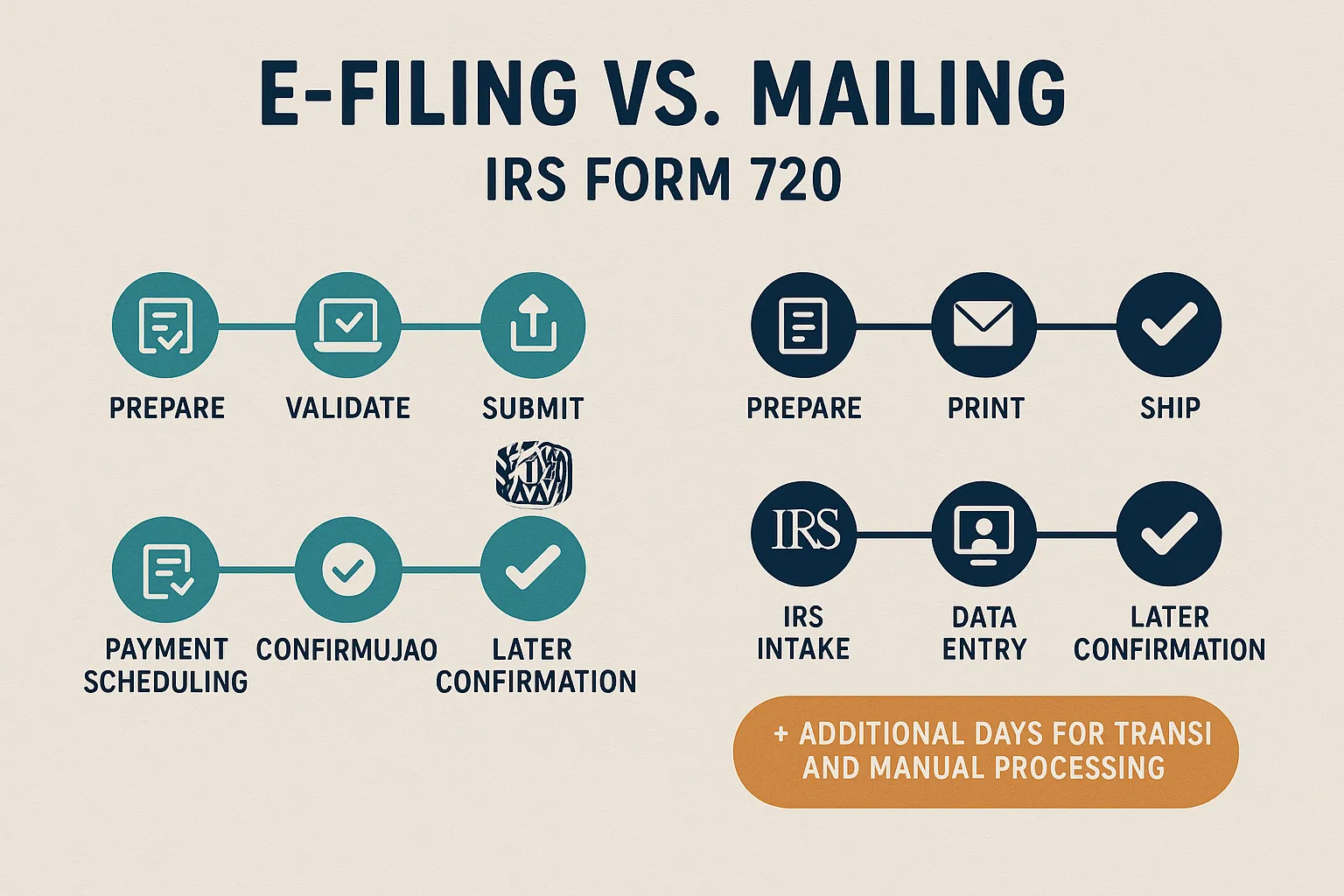
If you are weighing whether to e file IRS Form 720 or put a paper return in the mail, speed and certainty usually decide the winner. For most businesses, e-filing is faster to submit, faster to acknowledge, and less likely to be delayed by avoidable errors. Paper mailing still works, but postal transit, manual intake, and check processing add time and risk that can push you close to quarterly deadlines.
Below is a practical comparison so you can choose confidently for the current quarter and beyond.
What “faster” really means for Form 720
Speed for Form 720 covers several checkpoints:
- How quickly your return is received and acknowledged by the IRS
- How quickly you can fix a rejected return or correct data before it becomes a penalty problem
- How quickly payments are made and recorded
- How reliably you can prove timely filing if questioned later
The IRS consistently encourages businesses to e-file because electronic submissions are validated on receipt and move through systems faster than paper. See IRS guidance on e-file options for businesses and modernized e-file systems for background and benefits.
- IRS About Form 720: Quarterly Federal Excise Tax Return: https://www.irs.gov/forms-pubs/about-form-720
- Instructions for Form 720: https://www.irs.gov/instructions/i720
- E-file options for businesses: https://www.irs.gov/filing/e-file-options-for-businesses
E-file vs mail, speed at each step
| Step | E-file Form 720 | Mail Form 720 |
|---|---|---|
| Transmission | Online submission from an IRS-authorized provider, no postal lag | Postal or private carrier transit adds days, plus IRS intake time |
| IRS acknowledgment | Electronic acceptance or rejection notice, often same day or within a short period | No electronic status, proof relies on postmark or carrier records, processing updates are not immediate |
| Error handling | System validations catch many issues before submission, quick resubmission if rejected | Errors surface after IRS opens and keys the return, fixes can take longer and may require correspondence |
| Payment timing | Electronic options such as EFTPS or direct debit where available, clear payment scheduling | Paper check adds bank clearing time, mail delays may affect timely payment |
| Proof of timely filing | Electronic acknowledgment with date and time stamp | Postmark rule applies, but you must retain certified mail or designated private delivery service records |
For timely mailed, timely filed rules and which carriers qualify as designated private delivery services, see: https://www.irs.gov/filing/private-delivery-services-pds.
Why e-file is generally faster for Form 720
- Immediate IRS feedback. Electronic submissions receive an acceptance or a specific rejection code that you can fix quickly, which reduces the chance of late filing penalties due to undetected errors.
- Fewer manual touchpoints. Paper returns wait in queues for opening and data entry. E-filed data goes directly into IRS systems.
- Streamlined payments. You can schedule payment through the Electronic Federal Tax Payment System regardless of how you file, but e-filing and EFTPS together minimize mailing and check-clearing delays. Learn more about EFTPS: https://www.irs.gov/payments/eftps-the-electronic-federal-tax-payment-system.
- Clear audit trail. An e-file acknowledgment is concrete proof of when the IRS received your return.
When is mailing still reasonable?
Most filers will be better served by e-filing. Mailing may be considered if:
- You are responding to a specific IRS notice that instructs you to mail supporting documents with a return or letter.
- You have an unusual attachment that is not supported electronically. This is uncommon for Form 720 schedules because the IRS modernized e-file supports the core schedules that apply to most excise taxes.
- Your internal controls require paper originals. If so, consider e-file for the actual IRS submission and keep internal printouts for your records.
Even when you mail, protect your timeline. Use a designated private delivery service or certified mail, keep the receipt, and ensure the package is postmarked by the due date.
Quarterly deadlines you cannot miss
Form 720 is due on the last day of the month after the quarter ends. Missing these dates can trigger penalties and interest under the Instructions for Form 720.
| Quarter Covered | Filing Due Date |
|---|---|
| Q1, January to March | April 30 |
| Q2, April to June | July 31 |
| Q3, July to September | October 31 |
| Q4, October to December | January 31 |
Some filers, such as health plan sponsors paying the PCORI fee, typically file in Q2. E-filing helps avoid last minute delays during peak weeks in July.
Source: Instructions for Form 720, Due Date section: https://www.irs.gov/instructions/i720.
Accuracy and rejections, the hidden speed factor
Speed is not only transit time. It is how quickly you can get to an accepted return with the correct tax and schedules.
- E-file validations prevent common data entry mistakes such as missing EIN digits, invalid quarter selection, or incompatible schedules.
- If the IRS rejects an e-file, you get a coded reason quickly. You can correct and retransmit, often the same day.
- With paper, you may not discover an issue until the IRS processes the return and sends a letter, which can take weeks.
The IRS repeatedly notes that electronic filing reduces errors compared with paper. See: https://www.irs.gov/filing/e-file-options-for-businesses.
Payments and credits
- If you owe excise tax, schedule a payment through EFTPS in advance of the due date, or use another IRS-accepted electronic method where available. This reduces the risk of late payment penalties caused by mail or check clearing.
- If you have a credit you want refunded, that is handled on Form 8849 rather than Form 720 for many claim types. See IRS About Form 8849: https://www.irs.gov/forms-pubs/about-form-8849.
Amending or fixing prior returns
If you need to amend a previously filed quarter, use Form 720-X. Having your original return in electronic form makes it faster to identify what changed and to prepare a complete amendment.
- IRS About Form 720-X: https://www.irs.gov/forms-pubs/about-form-720-x
How eFileExcise720 speeds things up in practice
eFileExcise720 is an IRS-authorized platform purpose-built for Form 720 and related filings. Choosing a provider that aligns with the IRS e-file program is a practical way to reduce friction at each step.
What you can expect from eFileExcise720 based on the service offering:
- IRS-authorized e-filing for Form 720
- Free account creation with no software to install
- Simple, guided dashboard to select the correct quarter and schedules
- Personalized customer support for Form 720 filing questions
- Secure data protection for sensitive business information
- Support for all Form 720 categories and industries
- Support for Form 720 amendments using Form 720-X
- Form 8849 support when a refund claim is applicable
These elements matter on deadline week. They reduce onboarding time, prevent avoidable errors, and give you an electronic acknowledgment you can rely on.
A quick decision guide
- You are close to the quarter deadline and need certainty. Choose e-file.
- You want an acknowledgment you can store for your records and auditors. Choose e-file.
- You need to coordinate payment timing through EFTPS and keep everything digital. Choose e-file.
- You must respond to a specific IRS letter that requests a mailed response with documents. Mail the response as instructed, and consider e-filing future quarterly returns.
Steps to e-file Form 720 today
- Create your free account at eFileExcise720.
- Enter business details, including EIN and contact information.
- Choose the tax quarter and add the applicable Form 720 schedules.
- Review calculated tax, credits, and any environmental, communications, transportation, fuel, or other excise categories that apply to your business.
- Select a payment approach accepted by the IRS, for example EFTPS, and schedule your payment to align with the due date.
- Transmit your return electronically and download the IRS acknowledgment for your records.
- If anything is flagged, correct and retransmit promptly so your filing remains on time.

Bottom line
If your goal is faster filing, faster acknowledgment, and fewer delays, e-file is the better route for Form 720. Paper mail still works, but transit and manual processing introduce time and uncertainty that are hard to justify, especially near quarter ends. Filing through an IRS-authorized provider designed for excise tax returns, such as eFileExcise720, gives you the speed, validation, and support that keep your business compliant without last minute stress.