

Can an Amended Return Be E-Filed? Everything You Need to Know
Most people assume an amended tax return has to be mailed, then they get stuck printing forms, finding tracking, and waiting weeks just to know the IRS received it. In 2026, that is often not necessary. The real answer to Can an Amended Return Be E-Filed is: sometimes yes, sometimes no, and it depends on the return type, tax year, and the system you use.
If you deal with federal excise taxes, the question gets even more specific: Can you e-file an amended Form 720 return (Form 720-X)? In many cases, yes, if you use an IRS-authorized e-file provider that supports amendments, such as E File Excise 720.
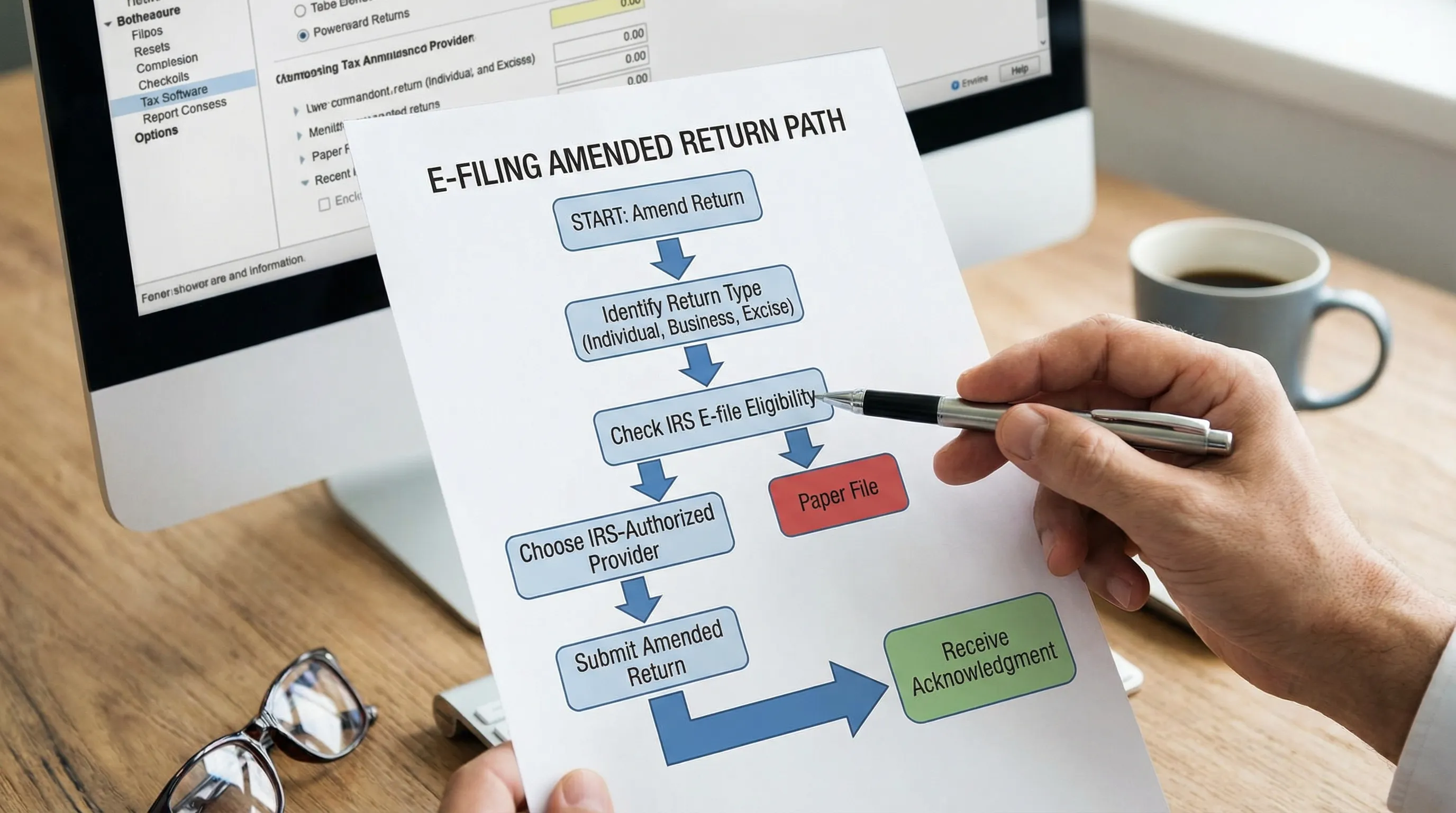
The quick answer (by return type)
Here is a practical overview of how e-filing amendments generally works. Always verify current IRS rules for your specific form and tax year.
| Return Type | Amended Form | Can it be e-filed? | What Usually Decides It |
|---|---|---|---|
| Individual income tax | Form 1040-X | Often yes (for many recent tax years) | IRS availability by tax year, your tax software/provider, and whether the original return was e-filed or paper filed |
| Corporate income tax | Form 1120-X | Often no (commonly paper) | IRS system limitations and form-specific rules |
| Partnership | Amended Form 1065 / AAR | Depends | Election used, tax year, and software support |
| Federal excise tax | Form 720-X (amended Form 720) | Often yes through supported IRS-authorized providers | Provider support, correct schedules/attachments, and complete original-period data |
| Excise refunds/credits | Form 8849 | Depends (often supported through specialized systems) | Claim type, schedules required, and provider support |
For reference, IRS forms and instructions live on the IRS website, including IRS Form 720 and IRS Form 8849.
Why e-filing amended returns is becoming the default
The IRS has steadily expanded electronic workflows because paper processing is expensive, slower to route, and easier to delay when volumes spike.
One simple data point shows where the market is headed: the IRS reports that more than 90% of individual tax returns are now filed electronically in recent years, as shown in the IRS Data Book (IRS Data Book). While that stat is for individuals, it reflects the broader direction: the IRS, tax software providers, and businesses are converging on digital filing as the standard.
What this trend means for amended returns
Even when your amendment is allowed electronically, your experience still depends on how cleanly the amendment is prepared.
E-filing tends to win when you care about:
Proof of filing (an electronic acknowledgment is a strong audit trail)
Faster error feedback (reject messages often arrive quickly if something is off)
Less operational friction (no printing, no postage, no tracking)
Paper can still make sense when the IRS requires wet signatures or original attachments, or when a specific amended form is not supported electronically.
Form 720 amendments: when you should use Form 720-X vs Form 8849
If your business deals with form 720 excise tax, you typically correct issues in one of two ways:
Form 720-X: Used to amend a previously filed irs form 720 for a specific quarter.
IRS Form 8849 (8849 form): Used to claim certain refunds, credits, or abatements (often tied to fuel and other excise categories), usually with supporting schedules.
The strategic question is not only “can I amend?” but also “what is the cleanest correction path that matches the IRS process for this issue?”
Common real-world reasons companies amend Form 720
These are patterns that show up across industries (transportation, manufacturing, insurance and benefits, chemicals, and more):
PCORI fee corrections: Many employers discover after filing that covered lives were miscounted, or the plan arrangement changed. People often call it a PCORI Form, but practically, the PCORI fee is reported on Form 720 typically due annually for PCORI purposes.
Rate or IRS number errors: Using the wrong IRS number for a product category can misstate tax.
Late discovery of taxable events: For example, a downstream billing system flags a transaction that should have been included as an excise line.
Credit or exemption documentation updated: You may have updated exemption certificates or export proof after filing.
Additional taxes assessed internally: After an audit or reconciliation, you may need to add liability for a prior quarter.
Can an amended Form 720 (720-X) be e-filed?
In many cases, yes, if you use a supported IRS-authorized provider. Because E File Excise 720 is built specifically around Form 720 workflows (including amendments), it can be a practical option when you want the speed and audit trail of e-filing without managing paper logistics.
What typically makes an amended excise return e-file successful is not just the button you click, but the completeness of the quarter’s story. The IRS wants a consistent narrative across:
The original quarter reported on Form 720
Your corrected figures on Form 720-X
Any schedules that support deposits, credits, or category-specific calculations

A simple e-filing workflow for excise amendments what to expect
Most businesses get better outcomes when they treat the amendment like a mini close process, not a quick fix.
Step 1: Rebuild the original quarter
Pull the same source inputs you used the first time (sales reports, taxable volumes, plan counts for PCORI, invoices, exemption documents). The goal is to understand whether the issue is:
A one-line correction
A systemic mapping error (for example, product-to-tax-code mapping)
A missing data feed that impacted multiple categories
Step 2: Decide whether it is a 720-X amendment or an 8849 claim
This is where many teams lose time. If the correction is actually a claim pattern that fits irs form 8849, filing the wrong way can create back-and-forth.
When in doubt, confirm using IRS instructions and your tax advisor.
Step 3: File electronically and keep the acknowledgment
E-filing matters because it creates a digital receipt. If you later need to prove when you filed (for penalty discussions or audit timelines), that acknowledgment is extremely useful.
Pricing and cost strategy: the hidden cost of “free” amendments
People ask about pricing plans because they assume the cheapest method is always best. For amendments, the cheapest option on paper can be the most expensive operationally.
Here is a cost-focused comparison that many finance teams use.
| Option | Direct Cost | Indirect Cost (Time and Risk) | Best For |
|---|---|---|---|
| Paper filing an amendment | Low postage, low tools cost | Higher admin time, harder tracking, higher risk of lost mail or missing proof | Very small volume, or when IRS requires paper |
| Using a CPA firm for the amendment | Higher professional fees | Lower risk, but turnaround depends on schedules | Complex issues, multi-entity corrections |
| IRS-authorized e-file provider built for Form 720/720-X/8849 | Typically a filing fee | Lower admin time, faster acknowledgment, better repeatability | Teams that want speed, consistency, and documentation |
If you are evaluating an e-file provider, focus on total cost: how long it takes your team to prepare, file, confirm acceptance, and store documentation. That is where e-filing usually wins.
Lessons learned from investor-style diligence
In acquisitions and financing rounds, excise compliance can show up as a surprise liability. A common diligence pattern is:
A buyer reviews tax exposure and discovers a target company had a filing obligation for form 720 excise tax fuel, communications, air transportation, benefits-related fees like PCORI, or other categories.
The deal team negotiates escrow or purchase price adjustments based on the estimated exposure.
Post-close, the company must rapidly clean up prior quarters, often through amendments and claims.
The takeaway is simple: amendments are not just tax hygiene. They protect valuation by reducing uncertainty around additional taxes, penalties, and open-ended exposure.
Frequently Asked Questions
Can an Amended Return Be E-Filed for all tax forms?
No. Some amended returns can be e-filed, but others still require paper, depending on the IRS form and tax year.
Can I e-file an amended Form 720 return?
Often yes, by using an IRS-authorized provider that supports Form 720-X electronic filing.
Is the PCORI fee filed on a separate PCORI Form?
No. The PCORI fee is generally reported on IRS Form 720, even though people commonly call it a PCORI form.
Should I use Form 720-X or IRS Form 8849?
Use Form 720-X to amend a filed Form 720 quarter, and use Form 8849 to claim certain refunds or credits, depending on the situation.
Do I have to pay when I file an amendment?
If the amendment increases tax, you generally need to pay the additional amount, plus any applicable interest or penalties.
File Form 720 amendments online with less friction
If you are correcting a prior quarter, speed and proof matter. eFileExcise720 is an IRS-authorized e-filing portal designed for excise returns, including Form 720, Form 720-X amendments, and Form 8849 claims, without software downloads.
To streamline your next amendment, you can start at eFileExcise720 and follow the guided process to prepare and transmit your corrected filing securely.