

How Long After E-Filing to Get a Tax Refund?
If you e-filed a tax return and are waiting on a refund, the short answer is this: many IRS refunds are issued within 21 days after an electronically filed return is accepted, but that is not a guarantee. Your actual timeline depends on the type of return, how you requested the refund, whether the IRS needs additional review, and whether your filing involves income tax or federal excise tax.
For 2026, the fastest path is still e-filing with direct deposit. Paper filing, missing information, identity checks, amended returns, and certain credits can add weeks or months.
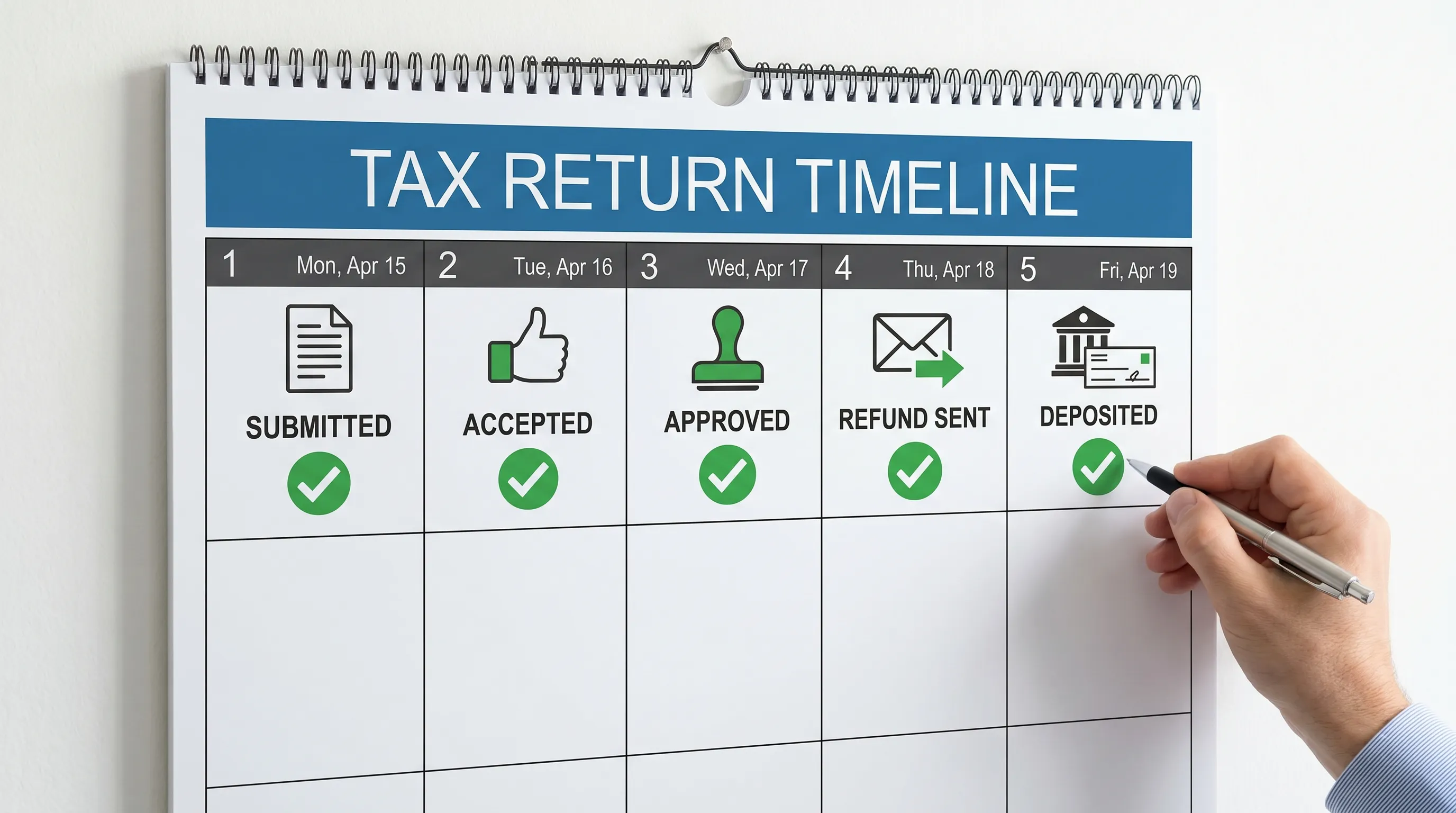
Quick Answer: How Long After E-Filing to Get a Tax Refund?
According to the IRS refund guidance, taxpayers can usually check refund status within 24 hours after the IRS receives an e-filed current-year individual return. Most refunds are issued in less than 21 days when the return is complete, accurate, and set up for direct deposit.
However, “e-filed” does not mean “instantly refunded.” First, the IRS must accept the return. Then it must process the return, approve the refund, and release the payment.
For businesses dealing with federal excise taxes, the timeline can be different. Form 720 is generally used to report and pay quarterly federal excise tax, not to receive a standard refund like an individual Form 1040. If you overpaid excise tax or qualify for a claim, you may need to use Form 8849 for an excise tax refund claim or another appropriate IRS procedure.
2026 Tax Refund Timeline After E-Filing
Here is a practical timeline for a typical electronically filed individual tax return with direct deposit:
| Stage | Typical timing | What it means |
|---|---|---|
| Return submitted | Same day | You or your preparer transmits the return electronically |
| IRS acceptance | Minutes to 48 hours in many cases | The IRS confirms the return passed basic validation |
| Refund status available | About 24 hours after e-filing a current-year return | You can begin checking IRS “Where’s My Refund?” |
| Refund approved | Often within 1 to 3 weeks | The IRS finishes processing and authorizes payment |
| Refund sent | Usually within 21 days for many e-filed returns | Direct deposit or check is released |
| Bank posting | Same day to several business days | Your bank makes the funds available |
This timeline assumes the return has no errors, no suspected identity issue, no missing forms, and no special review.
Why “Accepted” Does Not Mean “Refund Approved”
One of the most common misunderstandings is confusing IRS acceptance with refund approval. When a return is accepted, the IRS has received it and confirmed that basic details match its system, such as the taxpayer identification number and filing format.
Refund approval is a later step. The IRS still reviews income, withholding, credits, deductions, dependents, payment information, and other items. If anything looks incomplete or inconsistent, the refund may be delayed.
For excise tax filers, this distinction also matters. When you e-file Form 720 through an IRS-authorized platform such as eFileExcise720, acceptance confirms that the return was transmitted and received. It does not mean the IRS has approved a refund, because Form 720 is mainly a reporting and payment return. Refunds or claims usually involve separate eligibility and documentation.
What Can Delay a Refund After E-Filing?
Even when you e-file correctly, some refunds take longer than 21 days. Common reasons include:
- Incorrect Social Security number, EIN, or bank account information
- Missing income documents or mismatched wage reporting
- Claiming refundable credits that require additional review
- Identity verification or possible fraud screening
- Filing an amended return instead of an original return
- Requesting a paper check rather than direct deposit
- IRS backlogs, correspondence, or manual review
- Incomplete documentation for excise tax refund claims
If you are a business required to file federal tax return forms such as Form 720, accuracy is especially important. Excise tax filings often depend on transaction data, gallons, barrels, premiums, taxable services, or product categories. Small reporting errors can create payment issues, amendments, or delayed claims later.
How Refund Timing Differs for Form 720 and Excise Tax Claims
A standard income tax refund and a federal excise tax refund are not the same process. This matters for businesses in fuel, transportation, environmental tax, communications, manufacturing, retail excise, indoor tanning, and other excise-taxable industries.
Form 720 is the Quarterly Federal Excise Tax Return. It is generally used to report excise taxes owed for a quarter. If you made an overpayment, need to correct a prior return, or qualify for a refund of certain excise taxes, you may need one of these routes:
| Situation | Possible IRS form | Purpose |
|---|---|---|
| You need to report quarterly excise tax | Form 720 | File and pay federal excise tax |
| You need to correct a Form 720 error | Form 720-X | Amend a previously filed excise return |
| You qualify for a refund or claim | Form 8849 | Claim certain excise tax refunds |
Before filing a claim, review who qualifies for a federal excise tax refund. For example, some fuel-related claims depend on how the fuel was used, whether tax was previously paid, and whether records support the claim.
How to Track Your Refund Status
For individual income tax refunds, the IRS “Where’s My Refund?” tool is the primary tracking option. You typically need your Social Security number or ITIN, filing status, and exact refund amount.
For business excise filings, keep a complete filing record. Save your IRS acknowledgement, payment confirmation, copies of supporting schedules, and any correspondence. If your business travels frequently for audits, client meetings, or compliance reviews, it can also help to keep organized expense records for related services such as nationwide corporate transportation, especially when reconciling business travel documentation.
If you filed through eFileExcise720, use your account records and dashboard to help track submitted filings and acknowledgements. For deadline planning, see the Form 720 due date guide and the 2026 Form 720 e-filing checklist.
Tips to Get Your Refund Faster in 2026
The IRS repeatedly encourages electronic filing because it reduces manual processing and common paper-return issues. To improve your chances of a smoother refund timeline, use direct deposit, double-check taxpayer details, reconcile income and payment records before filing, and respond quickly to any IRS notice.
For excise tax filers, preparation is the real speed advantage. Gather taxable activity data before the quarter ends, confirm the correct IRS numbers and tax categories, and maintain records that support credits or refund claims. If you need to file Form 720, Form 720-X, or Form 8849, using an IRS-authorized e-filing provider can reduce avoidable errors and provide faster submission confirmation than paper filing.
Frequently Asked Questions
How long does it take to get a refund after e-filing in 2026?
Many electronically filed individual tax refunds are issued within 21 days after IRS acceptance, especially with direct deposit. Some returns take longer if they require additional review.
Can I check my refund the same day I e-file?
Usually, you should wait about 24 hours after e-filing a current-year individual return before checking IRS refund status.
Does e-filing Form 720 create a refund?
Not usually. Form 720 is mainly used to report and pay quarterly federal excise taxes. Excise tax refunds generally require a valid claim, often through Form 8849, depending on the situation.
Why is my refund delayed even though my return was accepted?
Acceptance only means the IRS received the return and it passed basic checks. Delays can happen because of errors, identity verification, missing information, manual review, or special refund rules.
Is direct deposit faster than a paper check?
Yes. Direct deposit is generally faster and safer than waiting for a paper check to be mailed and processed.
File Excise Tax Returns Online With Confidence
If your refund question involves federal excise tax, the right form matters. eFileExcise720 helps businesses e-file Form 720 online through an IRS-authorized platform, with secure data handling, simple navigation, and support for Form 720 amendments and Form 8849 claims.
Ready to simplify your next excise tax filing? Create a free account with eFileExcise720 and prepare your federal excise tax return online without downloading software.